Essential Oils in Sauna: A Practical Guide to Aromatherapy and Heat
Essential Oils in Sauna: A Practical Guide to Aromatherapy and Heat
Adding essential oils to a sauna feels like a small ritual. A few drops, a ladle of water, the room shifting in scent and feel. Done well, it deepens the practice. Done carelessly, it sends sharp fumes into a hot, sealed room. Here is what actually matters.
Adding essential oils to a sauna feels like a small ritual. A few drops, a ladle of water, the room shifting in scent and feel. Done well, it deepens the practice. Done carelessly, it sends sharp fumes into a hot, sealed room. Here is what actually matters.
Published on:
Published on:
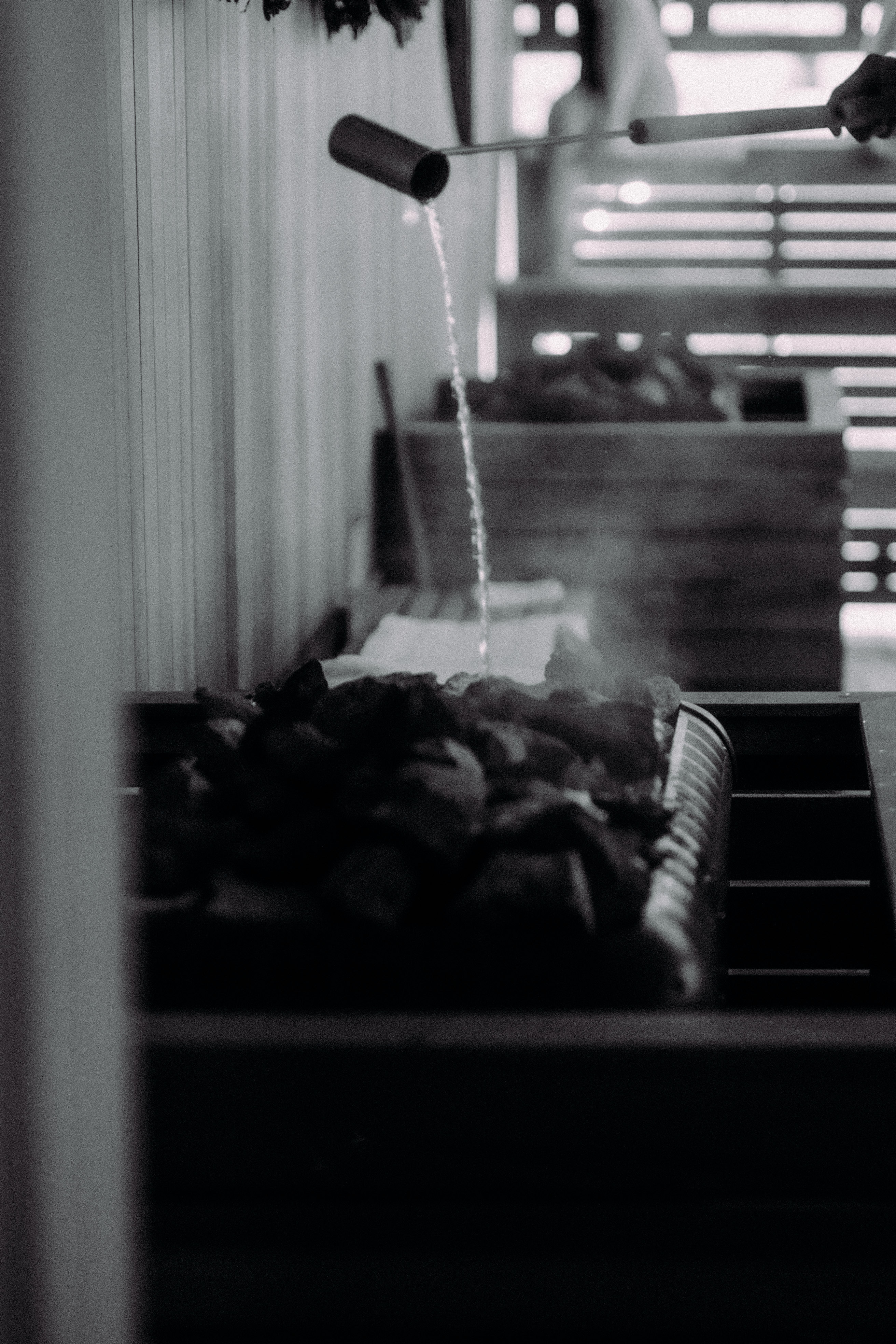
Essential oils in a sauna are added to water, then poured slowly onto the hot stones, where the steam carries the scent into the air. The most common oils are eucalyptus, peppermint, lavender, cedarwood, pine, and birch. The rules are simple: never put oil directly on the stones, always dilute in water, and use only a few drops at a time.
At AetherHaus, our guides add essential oils to the stove throughout the day. It is part of the rhythm of the room, especially in our Aufguss sessions, where scented steam, music, and rhythmic towel work move waves of warmth across the body. Aromatherapy is not the headline. It is the air you breathe while you settle in.
This guide covers what aromatherapy actually does in a sauna, the safety rules that matter, the most common oils and what they do, and how we approach it in our practice.

What Aromatherapy in a Sauna Actually Does
Aromatherapy is the practice of inhaling concentrated plant extracts to influence mood, breathing, and overall comfort. In a sauna, the high heat and steam carry those compounds into the air more efficiently than a diffuser ever could. You are not just sitting in scent. You are breathing it in deeply, with your respiratory system already opened up by the heat.
The science is still developing, but the direction is promising. When you inhale essential oils, the scent molecules travel through the olfactory nerves directly to the brain, especially the amygdala, which is part of how mood and memory get processed (Johns Hopkins Medicine, 2025).
A 2023 systematic review of clinical research found that inhalation aromatherapy has measurable potential to reduce stress and anxiety in clinical settings, though the authors noted a clear need for more standardized protocols (ScienceDirect, 2023).
Lavender, in particular, has the most clinical research behind it. Multiple controlled studies have linked inhaled lavender to reductions in anxiety and improved sleep quality (Frontiers in Pharmacology, 2022).
None of this is a cure for anything. What aromatherapy in a sauna is actually doing is making the room feel different. Calmer. Sharper. Greener. The body responds to that, just like it responds to music or light.
Safety First: How to Use Essential Oils in a Sauna Without Hurting Anyone
This is the part most articles bury at the bottom. We are putting it near the top because pouring undiluted essential oil onto a 200°C stove is a real risk, and most people doing it at home do not know that.
Never Pour Oil Directly Onto the Stones
Essential oils are flammable. Pure oil hitting hot stones can ignite or release a sharp, irritating cloud of vapour that hurts to breathe. The rule is simple: oil always goes into water first, then the water gets ladled onto the stones. The water carries the scent and protects the oil from direct contact with the heat.
Dilute Properly
Five to ten drops of essential oil per litre of water is plenty. For a single ladle, three to five drops is usually enough. More is not better. Strong oils in a small, sealed room can quickly become overwhelming and irritate the eyes, nose, and lungs.
Use Only Pure Essential Oils
Synthetic fragrance oils are made for diffusers and candles, not heat. When they hit hot stones, they can release compounds that irritate the airways. Look for bottles labelled 100 percent pure essential oil with the Latin botanical name on the label. If a label just says "fragrance oil" or "aroma oil," it does not belong in a sauna.
Be Mindful of Other People in the Room
A sauna is a shared space. What smells lovely to you might trigger a headache or a respiratory reaction in someone else. People with asthma, allergies, or sensitivities to strong scents should be checked in with before strong oils like peppermint or eucalyptus go on the stones.
Skip Strong Oils During Pregnancy and With Small Children
Some essential oils, especially camphor-rich and eucalyptus-rich ones, are not recommended during pregnancy or for small children. Anyone with a medical condition, who is pregnant, or who is unsure should check with a healthcare provider before regular sauna aromatherapy.
The Most Common Sauna Essential Oils and What They Do
These are the oils that show up most often in sauna traditions across Finland, Russia, Germany, and beyond. Each one shifts the room differently. Some open you up. Some calm you down. Some bring the forest inside.
Eucalyptus
The classic. Eucalyptus is the most common essential oil used in saunas worldwide. It has a sharp, fresh, slightly menthol scent that helps open the airways and clear sinus congestion.
A 2016 randomized controlled trial found that inhaled aromatherapy oils, including eucalyptus-based blends, helped reduce nasal symptoms and improved quality of life in adults with allergic rhinitis (NCBI, 2016).
Use it sparingly. Eucalyptus is potent, and a few drops is enough to fill the whole room.
Peppermint
Peppermint feels cool against the heat, which is part of why it works so well in a sauna. The contrast is part of the experience. The scent is bright, sharp, and energizing. It pairs beautifully with eucalyptus.
Same caution applies. Strong menthol oils can irritate the airways at high doses, so a couple of drops is plenty.
Lavender
Calmer than the menthol oils. Lavender shifts the room toward stillness and is one of the better choices for evening sessions or anytime you want to settle the mind.
Lavender has the most clinical research behind it of any essential oil. Multiple controlled studies have linked inhaled lavender to reductions in anxiety and improved sleep (Frontiers in Pharmacology, 2022).
Cedarwood
Earthy, warm, and grounded. Cedarwood feels like the inside of the sauna already smells, which is part of why it integrates so well. It does not announce itself. It just deepens what is already there.
A good choice when you want aromatherapy without anything sharp. Pairs well with most other oils.
Pine and Spruce
Forest oils. Pine and spruce bring a clean, woody scent that feels at home in any sauna. In Nordic and Russian traditions, these scents are part of the heritage of the practice itself.
They tend to be gentler on the lungs than menthol oils, which makes them a good choice for longer sessions.
Birch
Birch has been part of Russian banya and Finnish sauna tradition for centuries. It has a sweet, slightly minty aroma and is often associated with the leaf-bundle (venik or vihta) work that traditionally accompanies these sessions.
Citrus Oils (Orange, Bergamot, Lemon)
Brighter and lighter than the deeper oils. Citrus is mood-lifting and works well in morning or daytime sessions. Some citrus oils have a lower smoke point, so use them sparingly and never on direct heat.
How to Actually Apply Essential Oils in a Sauna
The method matters as much as the oil. Here is the practical version, the way it has been done in traditional saunas for generations.
The Standard Method: Water and a Ladle
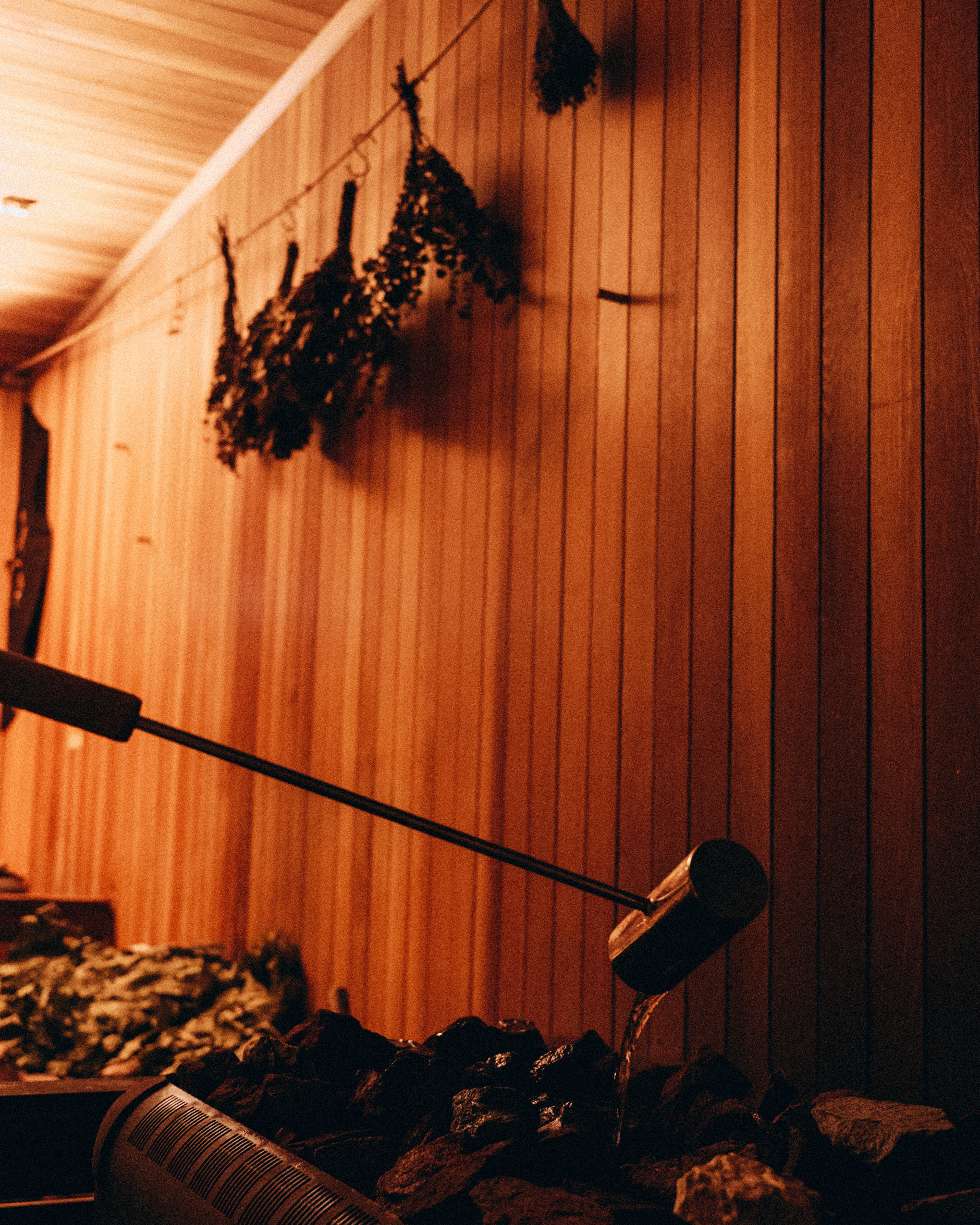
Add three to five drops of essential oil to a ladle of water. Stir briefly. Pour slowly onto the hot stones. The water carries the scent into steam, and the steam fills the room within seconds.
If your sauna has a wooden bucket, you can pre-mix a larger batch — about five to ten drops per litre — and ladle from there throughout the session.
The Snowball Method (Winter)
An old Finnish trick. Pack a snowball, drop a few drops of oil into it, and place the snowball on top of the heated stones. As it melts, the scented water releases slowly, giving you a longer, gentler aromatherapy build than a single ladle.
Our guides use this method during colder months. The slow melt creates a different rhythm than a sharp ladle pour.
Aroma Cups and Diffusers
Some saunas have a built-in aroma cup near the stove, designed to hold scented water above the heat without direct contact. This is a safer way to introduce aroma if you are uncertain about ladling. The scent develops more slowly but lasts longer.
Timing Within a Session
Most experienced practitioners add aroma in the middle of a session, after the room is fully heated and the body has settled in. Adding oil too early can feel sharp before the body is ready. Adding it during the deepest part of the session, when breathing has slowed and presence has arrived, is when it lands the most.
How AetherHaus Approaches Essential Oils
Aromatherapy is part of every session at AetherHaus, but it is rarely the focus. The point is not to perform a fragrance experience. It is to layer scent into a room that is already doing the work.
Our guides add essential oils to the stove throughout the day during Open Haus sessions. You might notice the room shift from earthy to bright to calm over the course of an hour. That is intentional. The atmosphere is read in real time, not run from a playlist. We also use a lighter aromatherapy touch during our silent sauna sessions, where the focus shifts toward stillness rather than ritual.
In our Aufguss sessions, aromatherapy plays a more deliberate role. Scented steam, rhythmic towel work, and music that builds and recedes all move the heat across the body in waves. The oils we use are chosen to fit the music, the moment, and what the room is asking for.
We use only pure essential oils, never synthetic fragrance. The difference is real. Synthetic fragrance breaks down in heat and leaves a chemical edge that lingers. Pure oils evaporate cleanly, leaving the room feeling cleaner, not dimmer, after each session.
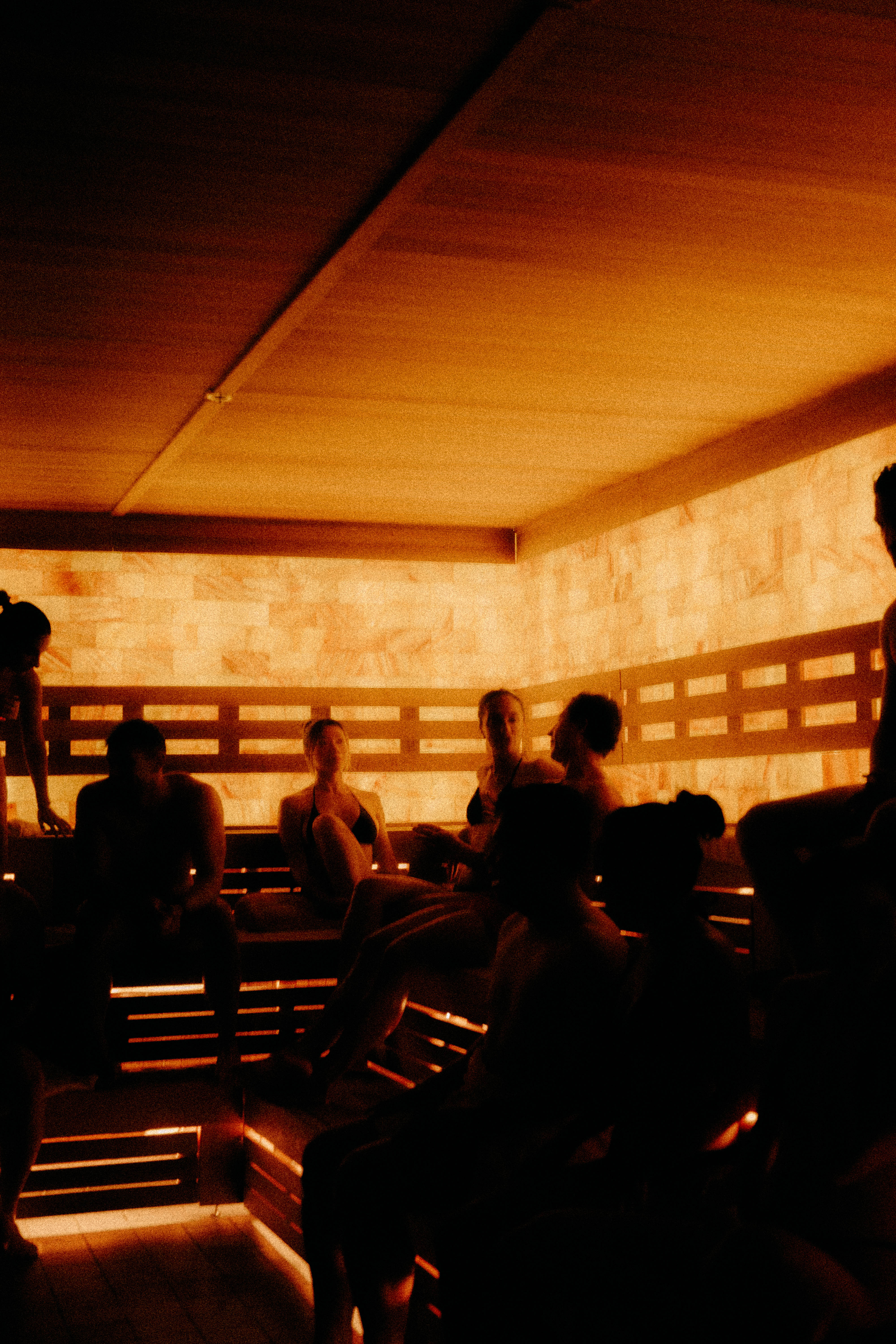
Our Himalayan salt sauna adds another layer. The salt wall changes how the air carries scent, and the warmth of the room interacts with the oils differently than a standard cedar sauna would. It is part of why our guests describe the air at AetherHaus as feeling distinct, even before the aromatherapy begins.

Common Mistakes to Avoid
Most people who run into trouble with sauna aromatherapy make one of a handful of avoidable mistakes.
Using Too Much Oil
More drops do not create a better experience. They create a sharp, irritating room that no one wants to be in. Start small and add gradually if needed. You can always pour more water on the stones to clear strong scent, but you cannot undo a heavy-handed application.
Pouring Oil Directly Onto the Stones
Already covered above, but worth repeating. Oil on hot stones can ignite or release a harsh chemical-smelling cloud. Always dilute in water first.
Mixing Too Many Oils At Once
Two or three oils at most per session. Five oils in the same ladle becomes a muddled scent that pleases no one. Simplicity is part of the craft.
Ignoring Other People in the Room
If you are in a shared sauna, ask before adding strong oils. A quick check-in respects everyone's experience and avoids someone leaving the room unhappy.
Buying Cheap Synthetic Oils
The cheapest "essential oils" on the shelf are usually fragrance oils with synthetic compounds. They are not safe in a sauna. Spend the money on real, pure oils. A small bottle lasts a long time when you are using three to five drops at a time.
Key Takeaways
Always dilute essential oils in water before adding to a sauna. Never pour oil directly onto hot stones.
Three to five drops per ladle, or five to ten drops per litre of water, is the standard dilution.
The most clinically researched aromatherapy oil is lavender, with documented effects on anxiety and sleep (Frontiers in Pharmacology, 2022).
Common sauna oils include eucalyptus, peppermint, lavender, cedarwood, pine, birch, and citrus. Each shifts the room differently.
Use only 100 percent pure essential oils. Synthetic fragrance oils are not safe in a sauna.
Want to experience aromatherapy in a guided sauna setting? Book a session at AetherHaus and let our guides handle the oils, the music, and the timing for you.
Frequently Asked Questions
Can you put essential oils directly on sauna stones?
No. Essential oils are flammable and can ignite or release sharp, irritating fumes when poured directly onto hot stones. Always dilute the oil in water first, then ladle the scented water onto the stones. This is the traditional and safe method used in Finnish, German, and Russian sauna practice.
How many drops of essential oil should I use in a sauna?
Three to five drops per ladle of water, or five to ten drops per litre if pre-mixing a larger batch. Stronger oils like peppermint and eucalyptus can be used at the lower end of that range. Citrus and lavender can go slightly higher. More is not better. A heavy hand can quickly make the room uncomfortable for everyone in it.
What essential oils are best for a sauna?
The most common are eucalyptus, peppermint, lavender, cedarwood, pine, birch, and citrus oils. Eucalyptus is the most popular for its airway-opening effect. Lavender is the most clinically researched for stress and sleep. Cedarwood and pine are gentler choices for longer sessions.
Are essential oils safe to inhale in a sauna?
For most healthy adults, yes, when properly diluted and used at safe doses. Inhaled aromatherapy has shown potential benefits for stress and anxiety in clinical research (ScienceDirect, 2023). People with asthma, allergies, or other respiratory conditions, those who are pregnant, and small children should be more cautious or check with a healthcare provider first.
What is the difference between essential oils and fragrance oils?
Essential oils are pure plant extracts, usually steam-distilled or cold-pressed. Fragrance oils are synthetic blends made for candles, perfumes, and diffusers, often containing alcohols and chemical fixatives. Fragrance oils are not safe in a sauna because they can release harmful compounds when heated. Always look for the words "100 percent pure essential oil" and the Latin botanical name on the label.
Can you use essential oils in an infrared sauna?
Infrared saunas do not have hot stones, so the ladle method does not apply. Instead, place a small diffuser inside the sauna, or put a few drops of oil on a damp washcloth and hang it in the room. The lower temperature of infrared saunas means the scent develops more slowly and gently than in a traditional sauna.
How often should you use essential oils in your sauna sessions?
There is no rule. Some people use them every session. Others save aromatherapy for specific moments — before bed, during recovery, or when something in the body needs a softer entry into the heat. Pay attention to how the oils land in your body and let that guide you. Read more about the benefits of sauna and cold plunge for context on building a sustainable practice.
Does AetherHaus use essential oils in sessions?
Yes. Our guides add pure essential oils to the stove throughout every Open Haus session, and aromatherapy plays a more deliberate role in our Aufguss rituals, where scented steam, music, and rhythmic towel work create waves of warmth across the body. We never use synthetic fragrance.
Step Into the Practice
Aromatherapy in a sauna is one of those small things that quietly changes the experience. The right oil, at the right moment, in the right amount, can shift a session from good to memorable.
If you are practicing at home, start with eucalyptus or lavender. Three drops in a ladle of water. See how the room responds.
If you would rather have it guided, book a session and step into a sauna where the oils, music, and rhythm are already in motion.
Essential oils in a sauna are added to water, then poured slowly onto the hot stones, where the steam carries the scent into the air. The most common oils are eucalyptus, peppermint, lavender, cedarwood, pine, and birch. The rules are simple: never put oil directly on the stones, always dilute in water, and use only a few drops at a time.
At AetherHaus, our guides add essential oils to the stove throughout the day. It is part of the rhythm of the room, especially in our Aufguss sessions, where scented steam, music, and rhythmic towel work move waves of warmth across the body. Aromatherapy is not the headline. It is the air you breathe while you settle in.
This guide covers what aromatherapy actually does in a sauna, the safety rules that matter, the most common oils and what they do, and how we approach it in our practice.
What Aromatherapy in a Sauna Actually Does
Aromatherapy is the practice of inhaling concentrated plant extracts to influence mood, breathing, and overall comfort. In a sauna, the high heat and steam carry those compounds into the air more efficiently than a diffuser ever could. You are not just sitting in scent. You are breathing it in deeply, with your respiratory system already opened up by the heat.
The science is still developing, but the direction is promising. When you inhale essential oils, the scent molecules travel through the olfactory nerves directly to the brain, especially the amygdala, which is part of how mood and memory get processed (Johns Hopkins Medicine, 2025).
A 2023 systematic review of clinical research found that inhalation aromatherapy has measurable potential to reduce stress and anxiety in clinical settings, though the authors noted a clear need for more standardized protocols (ScienceDirect, 2023).
Lavender, in particular, has the most clinical research behind it. Multiple controlled studies have linked inhaled lavender to reductions in anxiety and improved sleep quality (Frontiers in Pharmacology, 2022).
None of this is a cure for anything. What aromatherapy in a sauna is actually doing is making the room feel different. Calmer. Sharper. Greener. The body responds to that, just like it responds to music or light.
Safety First: How to Use Essential Oils in a Sauna Without Hurting Anyone
This is the part most articles bury at the bottom. We are putting it near the top because pouring undiluted essential oil onto a 200°C stove is a real risk, and most people doing it at home do not know that.
Never Pour Oil Directly Onto the Stones
Essential oils are flammable. Pure oil hitting hot stones can ignite or release a sharp, irritating cloud of vapour that hurts to breathe. The rule is simple: oil always goes into water first, then the water gets ladled onto the stones. The water carries the scent and protects the oil from direct contact with the heat.
Dilute Properly
Five to ten drops of essential oil per litre of water is plenty. For a single ladle, three to five drops is usually enough. More is not better. Strong oils in a small, sealed room can quickly become overwhelming and irritate the eyes, nose, and lungs.
Use Only Pure Essential Oils
Synthetic fragrance oils are made for diffusers and candles, not heat. When they hit hot stones, they can release compounds that irritate the airways. Look for bottles labelled 100 percent pure essential oil with the Latin botanical name on the label. If a label just says "fragrance oil" or "aroma oil," it does not belong in a sauna.
Be Mindful of Other People in the Room
A sauna is a shared space. What smells lovely to you might trigger a headache or a respiratory reaction in someone else. People with asthma, allergies, or sensitivities to strong scents should be checked in with before strong oils like peppermint or eucalyptus go on the stones.
Skip Strong Oils During Pregnancy and With Small Children
Some essential oils, especially camphor-rich and eucalyptus-rich ones, are not recommended during pregnancy or for small children. Anyone with a medical condition, who is pregnant, or who is unsure should check with a healthcare provider before regular sauna aromatherapy.
The Most Common Sauna Essential Oils and What They Do
These are the oils that show up most often in sauna traditions across Finland, Russia, Germany, and beyond. Each one shifts the room differently. Some open you up. Some calm you down. Some bring the forest inside.
Eucalyptus
The classic. Eucalyptus is the most common essential oil used in saunas worldwide. It has a sharp, fresh, slightly menthol scent that helps open the airways and clear sinus congestion.
A 2016 randomized controlled trial found that inhaled aromatherapy oils, including eucalyptus-based blends, helped reduce nasal symptoms and improved quality of life in adults with allergic rhinitis (NCBI, 2016).
Use it sparingly. Eucalyptus is potent, and a few drops is enough to fill the whole room.
Peppermint
Peppermint feels cool against the heat, which is part of why it works so well in a sauna. The contrast is part of the experience. The scent is bright, sharp, and energizing. It pairs beautifully with eucalyptus.
Same caution applies. Strong menthol oils can irritate the airways at high doses, so a couple of drops is plenty.
Lavender
Calmer than the menthol oils. Lavender shifts the room toward stillness and is one of the better choices for evening sessions or anytime you want to settle the mind.
Lavender has the most clinical research behind it of any essential oil. Multiple controlled studies have linked inhaled lavender to reductions in anxiety and improved sleep (Frontiers in Pharmacology, 2022).
Cedarwood
Earthy, warm, and grounded. Cedarwood feels like the inside of the sauna already smells, which is part of why it integrates so well. It does not announce itself. It just deepens what is already there.
A good choice when you want aromatherapy without anything sharp. Pairs well with most other oils.
Pine and Spruce
Forest oils. Pine and spruce bring a clean, woody scent that feels at home in any sauna. In Nordic and Russian traditions, these scents are part of the heritage of the practice itself.
They tend to be gentler on the lungs than menthol oils, which makes them a good choice for longer sessions.
Birch
Birch has been part of Russian banya and Finnish sauna tradition for centuries. It has a sweet, slightly minty aroma and is often associated with the leaf-bundle (venik or vihta) work that traditionally accompanies these sessions.
Citrus Oils (Orange, Bergamot, Lemon)
Brighter and lighter than the deeper oils. Citrus is mood-lifting and works well in morning or daytime sessions. Some citrus oils have a lower smoke point, so use them sparingly and never on direct heat.
How to Actually Apply Essential Oils in a Sauna
The method matters as much as the oil. Here is the practical version, the way it has been done in traditional saunas for generations.
The Standard Method: Water and a Ladle
Add three to five drops of essential oil to a ladle of water. Stir briefly. Pour slowly onto the hot stones. The water carries the scent into steam, and the steam fills the room within seconds.
If your sauna has a wooden bucket, you can pre-mix a larger batch — about five to ten drops per litre — and ladle from there throughout the session.
The Snowball Method (Winter)
An old Finnish trick. Pack a snowball, drop a few drops of oil into it, and place the snowball on top of the heated stones. As it melts, the scented water releases slowly, giving you a longer, gentler aromatherapy build than a single ladle.
Our guides use this method during colder months. The slow melt creates a different rhythm than a sharp ladle pour.
Aroma Cups and Diffusers
Some saunas have a built-in aroma cup near the stove, designed to hold scented water above the heat without direct contact. This is a safer way to introduce aroma if you are uncertain about ladling. The scent develops more slowly but lasts longer.
Timing Within a Session
Most experienced practitioners add aroma in the middle of a session, after the room is fully heated and the body has settled in. Adding oil too early can feel sharp before the body is ready. Adding it during the deepest part of the session, when breathing has slowed and presence has arrived, is when it lands the most.
How AetherHaus Approaches Essential Oils
Aromatherapy is part of every session at AetherHaus, but it is rarely the focus. The point is not to perform a fragrance experience. It is to layer scent into a room that is already doing the work.
Our guides add essential oils to the stove throughout the day during Open Haus sessions. You might notice the room shift from earthy to bright to calm over the course of an hour. That is intentional. The atmosphere is read in real time, not run from a playlist. We also use a lighter aromatherapy touch during our silent sauna sessions, where the focus shifts toward stillness rather than ritual.
In our Aufguss sessions, aromatherapy plays a more deliberate role. Scented steam, rhythmic towel work, and music that builds and recedes all move the heat across the body in waves. The oils we use are chosen to fit the music, the moment, and what the room is asking for.
We use only pure essential oils, never synthetic fragrance. The difference is real. Synthetic fragrance breaks down in heat and leaves a chemical edge that lingers. Pure oils evaporate cleanly, leaving the room feeling cleaner, not dimmer, after each session.
Our Himalayan salt sauna adds another layer. The salt wall changes how the air carries scent, and the warmth of the room interacts with the oils differently than a standard cedar sauna would. It is part of why our guests describe the air at AetherHaus as feeling distinct, even before the aromatherapy begins.
Common Mistakes to Avoid
Most people who run into trouble with sauna aromatherapy make one of a handful of avoidable mistakes.
Using Too Much Oil
More drops do not create a better experience. They create a sharp, irritating room that no one wants to be in. Start small and add gradually if needed. You can always pour more water on the stones to clear strong scent, but you cannot undo a heavy-handed application.
Pouring Oil Directly Onto the Stones
Already covered above, but worth repeating. Oil on hot stones can ignite or release a harsh chemical-smelling cloud. Always dilute in water first.
Mixing Too Many Oils At Once
Two or three oils at most per session. Five oils in the same ladle becomes a muddled scent that pleases no one. Simplicity is part of the craft.
Ignoring Other People in the Room
If you are in a shared sauna, ask before adding strong oils. A quick check-in respects everyone's experience and avoids someone leaving the room unhappy.
Buying Cheap Synthetic Oils
The cheapest "essential oils" on the shelf are usually fragrance oils with synthetic compounds. They are not safe in a sauna. Spend the money on real, pure oils. A small bottle lasts a long time when you are using three to five drops at a time.
Key Takeaways
Always dilute essential oils in water before adding to a sauna. Never pour oil directly onto hot stones.
Three to five drops per ladle, or five to ten drops per litre of water, is the standard dilution.
The most clinically researched aromatherapy oil is lavender, with documented effects on anxiety and sleep (Frontiers in Pharmacology, 2022).
Common sauna oils include eucalyptus, peppermint, lavender, cedarwood, pine, birch, and citrus. Each shifts the room differently.
Use only 100 percent pure essential oils. Synthetic fragrance oils are not safe in a sauna.
Want to experience aromatherapy in a guided sauna setting? Book a session at AetherHaus and let our guides handle the oils, the music, and the timing for you.
Frequently Asked Questions
Can you put essential oils directly on sauna stones?
No. Essential oils are flammable and can ignite or release sharp, irritating fumes when poured directly onto hot stones. Always dilute the oil in water first, then ladle the scented water onto the stones. This is the traditional and safe method used in Finnish, German, and Russian sauna practice.
How many drops of essential oil should I use in a sauna?
Three to five drops per ladle of water, or five to ten drops per litre if pre-mixing a larger batch. Stronger oils like peppermint and eucalyptus can be used at the lower end of that range. Citrus and lavender can go slightly higher. More is not better. A heavy hand can quickly make the room uncomfortable for everyone in it.
What essential oils are best for a sauna?
The most common are eucalyptus, peppermint, lavender, cedarwood, pine, birch, and citrus oils. Eucalyptus is the most popular for its airway-opening effect. Lavender is the most clinically researched for stress and sleep. Cedarwood and pine are gentler choices for longer sessions.
Are essential oils safe to inhale in a sauna?
For most healthy adults, yes, when properly diluted and used at safe doses. Inhaled aromatherapy has shown potential benefits for stress and anxiety in clinical research (ScienceDirect, 2023). People with asthma, allergies, or other respiratory conditions, those who are pregnant, and small children should be more cautious or check with a healthcare provider first.
What is the difference between essential oils and fragrance oils?
Essential oils are pure plant extracts, usually steam-distilled or cold-pressed. Fragrance oils are synthetic blends made for candles, perfumes, and diffusers, often containing alcohols and chemical fixatives. Fragrance oils are not safe in a sauna because they can release harmful compounds when heated. Always look for the words "100 percent pure essential oil" and the Latin botanical name on the label.
Can you use essential oils in an infrared sauna?
Infrared saunas do not have hot stones, so the ladle method does not apply. Instead, place a small diffuser inside the sauna, or put a few drops of oil on a damp washcloth and hang it in the room. The lower temperature of infrared saunas means the scent develops more slowly and gently than in a traditional sauna.
How often should you use essential oils in your sauna sessions?
There is no rule. Some people use them every session. Others save aromatherapy for specific moments — before bed, during recovery, or when something in the body needs a softer entry into the heat. Pay attention to how the oils land in your body and let that guide you. Read more about the benefits of sauna and cold plunge for context on building a sustainable practice.
Does AetherHaus use essential oils in sessions?
Yes. Our guides add pure essential oils to the stove throughout every Open Haus session, and aromatherapy plays a more deliberate role in our Aufguss rituals, where scented steam, music, and rhythmic towel work create waves of warmth across the body. We never use synthetic fragrance.
Step Into the Practice
Aromatherapy in a sauna is one of those small things that quietly changes the experience. The right oil, at the right moment, in the right amount, can shift a session from good to memorable.
If you are practicing at home, start with eucalyptus or lavender. Three drops in a ladle of water. See how the room responds.
If you would rather have it guided, book a session and step into a sauna where the oils, music, and rhythm are already in motion.
our Blog
our Blog
More insights
More insights
Explore more reflections, guidance, and practical tools to support you.
Explore more reflections, guidance, and practical tools to support you.

Most sauna sessions are full of small sounds. Quiet conversation, the hiss of water on stones, occasional laughter. A silent sauna strips that back. No talking. No phones. Just heat, breath, and whatever you brought in with you.

You have probably seen the claims. Sauna and cold plunge will fix your sleep, burn fat, boost your immune system, and make you feel like a new person. Some of those claims hold up under scrutiny. Others need more context than a social media post can offer.
You have probably seen the claims. Sauna and cold plunge will fix your sleep, burn fat, boost your immune system, and make you feel like a new person. Some of those claims hold up under scrutiny. Others need more context than a social media post can offer.
Your questions.
Answered.
Not sure what to expect? These answers might help you feel more confident as you begin.
Didn’t find your answer? Send us a message, we’ll respond with care and clarity.
What is a modern bathhouse?
A modern bathhouse keeps the architecture of the old idea, hot room, cold water, somewhere to rest, and lets the rhythm of the city around it shape the rest. Ours is built for Vancouver, on Davie Street, in the West End.
What is a modern bathhouse?
A modern bathhouse keeps the architecture of the old idea, hot room, cold water, somewhere to rest, and lets the rhythm of the city around it shape the rest. Ours is built for Vancouver, on Davie Street, in the West End.
Is the cold plunge at your bathhouse communal?
Is the cold plunge at your bathhouse communal?
Yes. Our cold pools are shared, with multiple temperature options so you can find one that meets you where you are. Communal plunging is part of what makes a bathhouse a bathhouse.
Is the bathhouse a welcoming space for the queer community?
Is the bathhouse a welcoming space for the queer community?
Yes. The West End is home to us and to our queer neighbours, and the bathhouse is built for everyone who walks in. We also host queer nights on a regular rotation, which you can find on the Classes calendar.
What's the etiquette inside the bathhouse?
What's the etiquette inside the bathhouse?
Phones stay in lockers. Voices stay low. Sit or lie on a towel inside the sauna, move at your own pace between rooms, and leave the space the way you'd want to find it. The room works because everyone in it is paying a little attention.
Do you offer Russian Banya at the bathhouse?
Do you offer Russian Banya at the bathhouse?
We run banya-inspired programming including venik work on select dates. The full ritual has its own page if you want to read about it before you book.
Do I need to book ahead, or can I walk in?
Do I need to book ahead, or can I walk in?
Walk-ins are welcome based on availability, but most guests book ahead through our app or website to lock in their preferred session time.
Your questions.
Answered.
Not sure what to expect? These answers might help you feel more confident as you begin.
What do I need to bring?
Please bring a bathing suit and a reusable water bottle. We provide two towels per guest, shower products, and secure lockers.
What do I need to bring?
Please bring a bathing suit and a reusable water bottle. We provide two towels per guest, shower products, and secure lockers.
Do I need a reservation?
Do I need a reservation?
Walk-ins are welcome, but we recommend booking through our app or website to check availability and join the waitlist.
Where can I park?
Where can I park?
Street parking is limited. We offer valet parking behind AetherHaus from 11:00–23:00. There is also some street parking available on Davie and nearby side streets.
What is Open Haus?
What is Open Haus?
Open Haus is a self-guided circuit through our saunas, plunge pools, and tea lounge. Our guides add essential oils to the stove throughout the day. The atmosphere shifts between silent, casual, and social, depending on the session.
What is your Haus Etiquette?
What is your Haus Etiquette?
Phones must be stored away. Please keep conversation soft, sit or lie on a towel, and move mindfully through the space. We ask that guests respect others’ experience and refrain from bringing outside food or drinks - complimentary tea is provided.
Can I visit if I am pregnant?
Can I visit if I am pregnant?
We advise against hot and cold therapy during pregnancy unless approved by your healthcare provider.
Didn’t find your answer? Send us a message, we’ll respond with care and clarity.
Your questions.
Answered.
Not sure what to expect? These answers might help you feel more confident as you begin.
Didn’t find your answer? Send us a message, we’ll respond with care and clarity.
What is a modern bathhouse?
A modern bathhouse keeps the architecture of the old idea, hot room, cold water, somewhere to rest, and lets the rhythm of the city around it shape the rest. Ours is built for Vancouver, on Davie Street, in the West End.
What is a modern bathhouse?
A modern bathhouse keeps the architecture of the old idea, hot room, cold water, somewhere to rest, and lets the rhythm of the city around it shape the rest. Ours is built for Vancouver, on Davie Street, in the West End.
Is the cold plunge at your bathhouse communal?
Is the cold plunge at your bathhouse communal?
Yes. Our cold pools are shared, with multiple temperature options so you can find one that meets you where you are. Communal plunging is part of what makes a bathhouse a bathhouse.
Is the bathhouse a welcoming space for the queer community?
Is the bathhouse a welcoming space for the queer community?
Yes. The West End is home to us and to our queer neighbours, and the bathhouse is built for everyone who walks in. We also host queer nights on a regular rotation, which you can find on the Classes calendar.
What's the etiquette inside the bathhouse?
What's the etiquette inside the bathhouse?
Phones stay in lockers. Voices stay low. Sit or lie on a towel inside the sauna, move at your own pace between rooms, and leave the space the way you'd want to find it. The room works because everyone in it is paying a little attention.
Do you offer Russian Banya at the bathhouse?
Do you offer Russian Banya at the bathhouse?
We run banya-inspired programming including venik work on select dates. The full ritual has its own page if you want to read about it before you book.
Do I need to book ahead, or can I walk in?
Do I need to book ahead, or can I walk in?
Walk-ins are welcome based on availability, but most guests book ahead through our app or website to lock in their preferred session time.