
How Long Should You Stay in a Sauna? What Science and Tradition Both Say
How Long Should You Stay in a Sauna? What Science and Tradition Both Say
The question sounds simple. The answer, it turns out, has as much to do with centuries of tradition as it does with modern research. Here is what the science says, what the cultures who invented sauna bathing actually practise, and how to listen to the only timer that truly matters: your body.
The question sounds simple. The answer, it turns out, has as much to do with centuries of tradition as it does with modern research. Here is what the science says, what the cultures who invented sauna bathing actually practise, and how to listen to the only timer that truly matters: your body.
Published on:
Published on:
Most research suggests that healthy adults can stay in a traditional sauna for 15 to 20 minutes per session (Harvard Health Publishing, 2020). Infrared saunas allow for longer sessions of 20 to 45 minutes because they operate at lower temperatures (Cleveland Clinic, 2022). But the number on a clock only tells part of the story.
The cultures that invented sauna bathing thousands of years ago never used timers. Finnish tradition, which UNESCO recognized as Intangible Cultural Heritage in 2020, guides sauna duration by body sensation and the quality of the steam, not by minutes (UNESCO, 2020). German Aufguss and Russian Banya traditions follow a similar principle: the experience has a natural rhythm, and your body knows when it is time to step out.
This guide covers what the research says, how different sauna types affect session length, what your body is telling you inside the heat, and what centuries of tradition reveal about a question that has less to do with the clock than most articles suggest. Whether you are new to sauna or deepening an existing practice, the answer starts with understanding your own body.
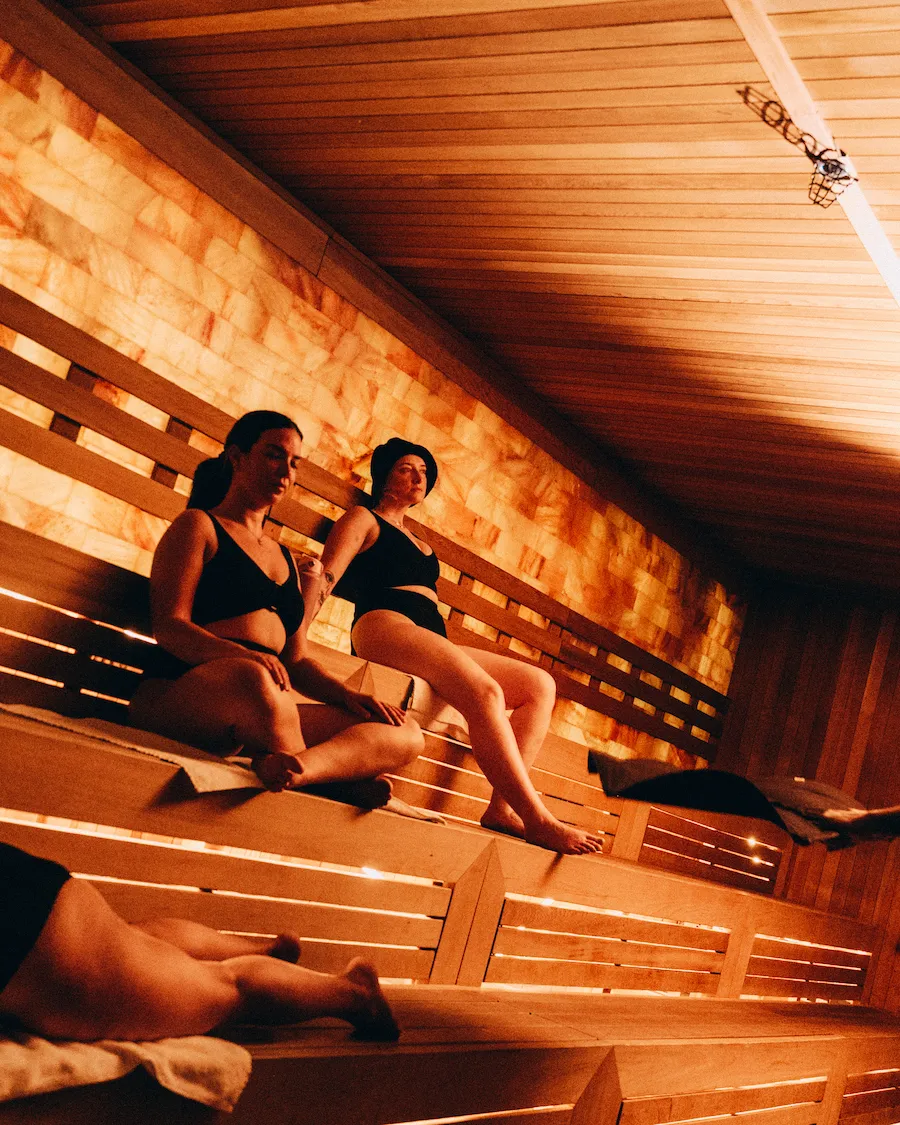
How Long Most People Stay in a Sauna
What the Research Recommends
The most widely cited sauna study comes from the University of Eastern Finland. Researchers followed 2,315 middle-aged men over a median of 20.7 years, tracking their sauna habits alongside cardiovascular outcomes (JAMA Internal Medicine, 2015).
Their findings shaped how we think about sauna duration today. Sessions lasting more than 19 minutes were associated with a 52% lower risk of sudden cardiac death compared to sessions under 11 minutes. Participants who used the sauna four to seven times per week had a 40% lower risk of all-cause mortality compared to those who visited once weekly.
A comprehensive review published in Mayo Clinic Proceedings confirmed these patterns across a broader evidence base. Sauna bathing was linked to reduced risk of vascular diseases, neurocognitive conditions, and improved quality of life (Mayo Clinic Proceedings, 2018). A follow-up study including both men and women found that cardiovascular mortality risk decreased linearly with increasing sauna frequency, with no threshold effect (BMC Medicine, 2018).
These studies offer a useful range. They do not offer a universal rule. The Finnish participants averaged 14 minutes per visit at roughly 175°F in traditional wood-fired saunas. Your experience may be quite different depending on the type of sauna, your health, and what your body needs that day.
Why Duration Depends on the Type of Sauna
Not all saunas create heat the same way. This changes how your body responds and how long you can comfortably stay inside.
Traditional Finnish saunas heat the air to between 150 and 195°F (65 to 90°C). The heat is intense and dry, with bursts of steam (called löyly) created by pouring water over heated stones. Most people spend 10 to 20 minutes per round before stepping out to cool down (Cleveland Clinic, 2022).
Infrared saunas work differently. Rather than heating the surrounding air, infrared panels warm the body directly at lower temperatures of 110 to 140°F (43 to 60°C). This allows for longer sessions of 20 to 45 minutes without the same level of cardiovascular strain (Cleveland Clinic, 2022).
Steam rooms operate at even lower temperatures of 110 to 120°F but with near-total humidity. Sessions of 10 to 15 minutes are typical. The moisture makes the heat feel more oppressive, which is why shorter stays tend to feel more comfortable.
Himalayan salt saunas, like the one at AetherHaus, combine dry heat with the mineral-rich environment of pink salt walls. Temperatures typically range from 130 to 170°F. Session length falls between traditional and infrared ranges. You can read more about the experience in our guide to the Himalayan salt sauna in Vancouver.
Sauna Type | Temperature Range | Typical Session |
|---|---|---|
Traditional Finnish | 150–195°F (65–90°C) | 10–20 minutes per round |
Infrared | 110–140°F (43–60°C) | 20–45 minutes |
Steam Room | 110–120°F (43–49°C) | 10–15 minutes |
Himalayan Salt | 130–170°F (55–77°C) | 15–30 minutes |
The type of sauna shapes the experience. But within any type, your body's signals matter more than the number on a chart.

Sauna Duration by Experience Level
If You Are New to Sauna
The most common advice for beginners is to start with shorter sessions and build from there (Harvard Health Publishing, 2025). That guidance is sound. But it does not need to become a rigid protocol you feel pressured to follow.
Here is what actually helps when you are starting out:
Start gently and notice how your body responds. There is no wrong amount of time for a first session.
Leave when you feel ready, not when a timer dictates. Some people feel comfortable after a few minutes. Others settle in for longer.
Sit on a lower bench if the heat feels overwhelming. Hot air rises, so the temperature can be meaningfully cooler lower down.
Cool down slowly afterward. Step outside, take a cool shower, or simply sit and let your body settle.
In my experience guiding hundreds of first-time guests at AetherHaus, the people who stay attuned to what their body is telling them have the most meaningful sessions. There is no such thing as "not lasting long enough." The invitation is to explore, not to endure.
For Regular Sauna Visitors
As you return to the sauna more often, your body adapts. Heat tolerance increases. You may notice that you can sit comfortably for longer periods before wanting a break.
This is natural. And it does not need to become another metric to track. Progression in the sauna is not about hitting a higher number. It is about deepening the quality of your presence in the heat. Some days you may feel like staying longer. Other days, a shorter visit is exactly what your body needs.
The Finnish study found that consistency mattered more than any single session length. The strongest associations with cardiovascular health came from regular sauna use over decades, not from maximizing minutes in any one visit (JAMA Internal Medicine, 2015).
This does not need to become another thing you are tracking in an app. Your body has been regulating temperature for millennia. Trust that.
After a Workout
If you use the sauna after exercise, your body is already in a heightened state. Heart rate is elevated. You have already been sweating. These are not reasons to avoid the sauna, but they do mean that your threshold for heat stress will be lower.
The same principles apply: listen to what your body is telling you, hydrate well, and step out when you feel ready. You can explore the research on this in more detail in our guide to sauna after workout recovery. For athletes incorporating sauna into a training routine, hydration before and after is especially important.

When to Step Out: What Your Body Is Telling You
The most important sauna timer is already built into your body. Learning to read its signals is more valuable than any stopwatch.
Signals That You Are Ready to Step Out
Your body communicates clearly in the heat. Part of the sauna practice is learning to distinguish between the comfortable signals that mean your body is working as designed and the warning signals that mean it is time for a break.
Comfortable signals (your body settling into the heat):
Gentle sweating across your skin
Warmth spreading through your limbs and muscles
Breathing deepening and slowing
A sense of softening or release in your body
Signals to step out (your body asking for a break):
Dizziness or lightheadedness
Rapid or pounding heartbeat
Nausea or a queasy feeling
Feeling faint, foggy, or confused
Headache that builds during the session
Discomfort that does not ease after adjusting your position
These are not failure signals. They are your body communicating clearly. Honouring them is the practice.
A case report published in the BMJ documented a woman in her early 70s who became unconscious after spending roughly 45 minutes in a sauna. She required hospital treatment for heat stroke (BMJ Case Reports, 2025). While extreme cases are rare, they illustrate why body awareness matters more than an arbitrary time goal.
In a separate study, three out of 22 women exposed to extremely high sauna temperatures lost consciousness before a 20-minute session ended (PMC/Frontiers in Physiology, 2024). Temperature, individual tolerance, and hydration all play a role. Duration alone does not tell the whole story.
Hydration and the Sauna
The average person loses roughly one pint of sweat during a short sauna session (Harvard Health Publishing, 2020). Longer sessions or higher temperatures increase that loss.
Practical hydration guidance:
Drink water before entering the sauna
Hydrate during breaks between rounds
Replenish after your session with water or electrolytes
Avoid alcohol before or during sauna use, as it impairs your body's ability to regulate heat
Who Should Consult a Doctor First
Sauna use is generally safe for most healthy adults. However, certain conditions require a conversation with your physician before using a sauna (Mayo Clinic Proceedings, 2018):
Unstable angina or recent heart attack
Uncontrolled high blood pressure
Severe aortic stenosis or decompensated heart failure
Pregnancy (consult your healthcare provider)
Medications that affect heart rate or sweating
If you are unsure whether sauna use is appropriate for you, speak with your doctor. This is especially important if you have cardiovascular conditions or are taking medications that affect how your body handles heat.

What Traditional Sauna Cultures Teach Us About Duration
Every top-ranking article on this topic gives you a number. None of them ask where that number came from, or what the cultures who have been practising sauna bathing for thousands of years actually do.
Finland: Stay As Long As You Feel Comfortable
Finland has approximately 3.3 million saunas for a population of 5.5 million. The sauna tradition stretches back as far as 7,000 years (National Geographic, 2024). Almost 90% of Finns take a sauna at least once a week. Many describe it as the key to their sense of presence and peace.
In 2020, UNESCO inscribed Finnish sauna culture on the Representative List of the Intangible Cultural Heritage of Humanity, describing it as a sacred space where people "cleanse their bodies and minds and embrace a sense of inner peace" (UNESCO, 2020).
The Finnish approach to duration? There is no timer. thisisFINLAND, the country's official cultural resource backed by the Ministry for Foreign Affairs, offers this guidance: stay in as long as you feel comfortable, and return to the sauna several times if you wish (thisisFINLAND, 2025).
At the heart of Finnish sauna culture is löyly, the steam created when water is poured over heated stones. The word originally meant "spirit," "breath," or "soul" in ancient Finnic languages (Wikipedia, 2025). The sauna experience has always been guided by the quality of the löyly and the sensations it produces, not by minutes on a clock.
The Finns, who gave the world the word "sauna," never needed a timer to tell them when to step out. They had something better: their body.
Germany and the Aufguss Ceremony
The German Aufguss tradition structures the sauna experience around ritual rather than duration. A trained Aufgussmeister guides the session through waves of heat, aroma, and towel movement. The experience has a natural arc: stillness, intensity, release. It ends when the ritual completes.
At AetherHaus, we practise Aufguss in darkness, with music, rhythmic heat waves, and aroma diffusion. The session moves through phases of challenge and surrender. Guests step out when the experience feels complete, not when a timer sounds.
You can learn more about this tradition and its Eastern European heritage, or explore what it takes to become a certified Aufgussmeister.
Russia and the Banya Tradition
The Russian Banya follows a rhythm of cycles: heat, cold, rest, repeat. Duration is shaped by the body's response to each cycle and the social ritual of the gathering. There is no single "session length" because the experience unfolds across multiple rounds.
If you are curious about the differences between these traditions, our guide to Banya vs Aufguss explores how Russian steam and German ceremony each approach the sauna in their own way.
The common thread across all three traditions: The cultures with the longest sauna histories share something striking. None of them prescribe a number of minutes. All of them trust the body to say when it is time.
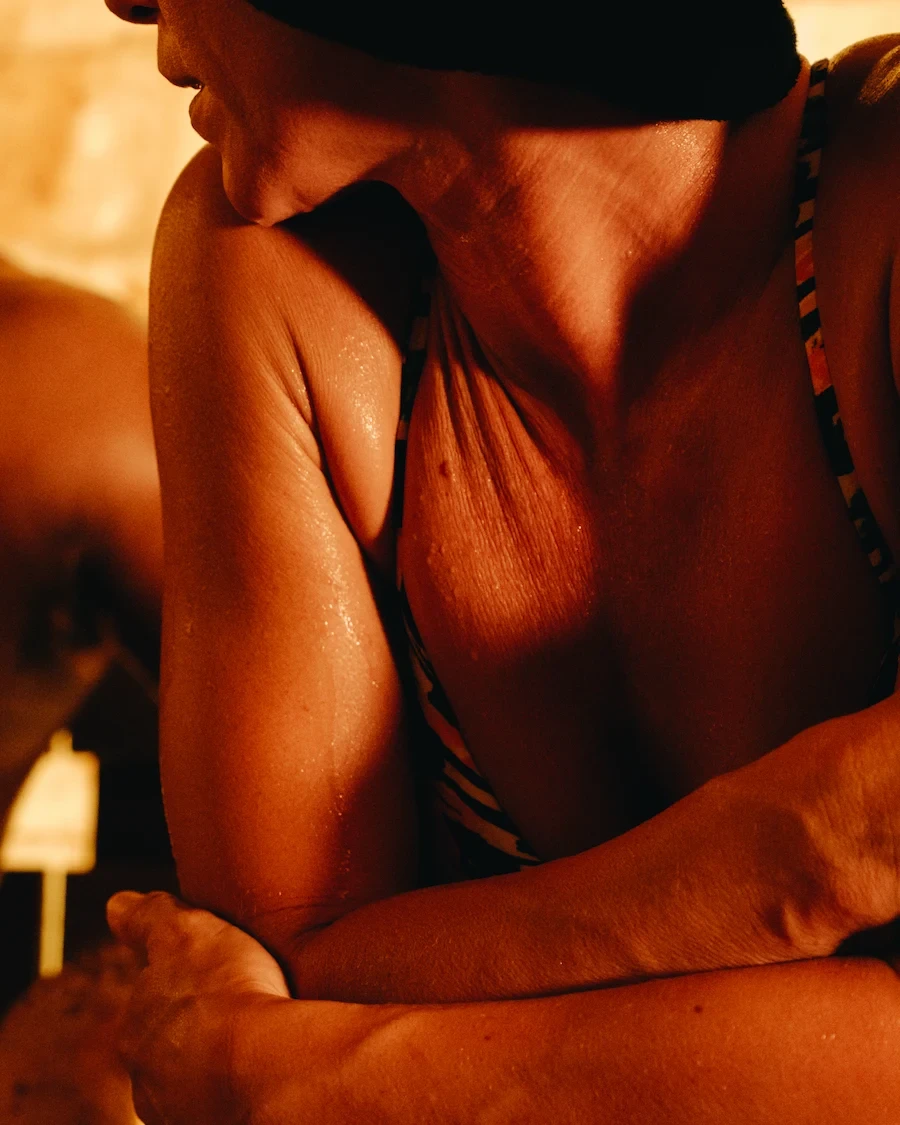
How to Find Your Own Sauna Duration
A Sensation-Based Approach
Rather than giving you another protocol to follow, here is a different way to think about sauna duration. Pay attention to what your body is telling you:
Notice warmth spreading. When heat moves from your skin into your muscles, your body is settling in.
Follow your breath. When breathing becomes laboured or shallow, it may be time for a break.
Trust the impulse to move. If your body wants to step out, that is not weakness. That is wisdom.
Pay attention to the shift. There is often a moment in the sauna when tension softens and your mind quiets. That is the experience doing its work.
There is no perfect duration. Your body will tell you when it is time. This is not about optimization. It is about presence.
In my own journey with cold exposure and sauna over the past decade, this is the lesson that changed everything. What they taught us at the Wim Hof camp was that it was not about time. It was about sensation and feeling. With an autoimmune condition, I had to be mindful of where my nervous system was at each day. Some days I might be in the cold for half a minute. Other days, several minutes. It was about learning what my body needed in the moment, not sticking to a prescriptive number.
The same principle applies in the sauna. Your body knows. The practice is learning to listen.
The Contrast Therapy Rhythm
Many experienced sauna practitioners follow a heat-cool-rest cycle rather than a single unbroken session. This is the foundation of contrast therapy, alternating between sauna heat and a cold plunge or cool shower, with periods of rest in between.
When practised this way, the sauna session is part of a larger rhythm. Duration in the heat is shaped by the entire cycle, not just the sauna portion. Each round may last a different amount of time. The body guides the transitions.
At AetherHaus in Vancouver, this rhythm is at the heart of everything we offer. Guests move between our Himalayan salt sauna, cold plunge pools, and tea lounge at their own pace. There are no clocks on the walls. The experience unfolds naturally. If you would like to explore this for yourself, you can book a session and discover what your body's rhythm feels like when there is nothing to measure it against.

Frequently Asked Questions
How long should a beginner stay in a sauna?
There is no required minimum. Start gently and leave when your body tells you it is ready. Many beginners find that 5 to 10 minutes feels comfortable in a traditional sauna. In an infrared sauna, 15 to 20 minutes is a common starting point. The goal is to notice how your body responds, not to hit a target (Harvard Health Publishing, 2025).
Is 30 minutes too long in a sauna?
In a traditional sauna at 170°F or higher, 30 continuous minutes may be more than most people can tolerate safely. In an infrared sauna at lower temperatures, 30 minutes falls within a comfortable range for experienced users (Cleveland Clinic, 2022). The clearest indicator is always how you feel, not the clock.
Can you stay in a sauna for an hour?
This is not recommended for traditional saunas. Extended exposure to high temperatures without breaks significantly increases the risk of dehydration and heat-related illness (BMJ Case Reports, 2025). Some infrared sauna users do spend longer periods at lower temperatures, but body signals should always take priority over time goals.
How long should you sauna after a workout?
The same principles apply as any other sauna session. Your body is already in a heightened state from exercise, so your heat tolerance may be lower. Hydration is especially important. Many post-workout sauna users find that 10 to 15 minutes feels adequate. For a deeper look at the research, see our guide to the science-backed benefits of sauna after a workout.
Is it safe to use a sauna every day?
For most healthy adults, daily sauna use is generally considered safe. The landmark Finnish study found that participants who used the sauna four to seven times per week had the strongest associations with reduced cardiovascular risk (JAMA Internal Medicine, 2015). However, anyone with underlying health conditions should consult their physician.
What is the difference between infrared and traditional sauna duration?
Traditional saunas heat the air to 150 to 195°F, creating an intense environment where sessions of 10 to 20 minutes are typical. Infrared saunas heat the body directly at lower temperatures of 110 to 140°F, allowing for sessions of 20 to 45 minutes (Cleveland Clinic, 2022). The mechanism of heat delivery, not just the temperature, explains the difference in comfortable session length.
What does löyly mean?
Löyly is the Finnish word for the steam created when water is poured over heated sauna stones. In ancient Finnic languages, the word originally carried the meaning of "spirit," "breath," or "soul" (Wikipedia, 2025). It sits at the heart of Finnish sauna culture and describes not just the steam itself, but the atmosphere it creates in the room. UNESCO recognized löyly as central to the Finnish sauna tradition when it inscribed the practice as Intangible Cultural Heritage (UNESCO, 2020).
Key Takeaways
Research suggests 15 to 20 minutes for traditional saunas, with sessions over 19 minutes linked to the strongest cardiovascular associations in a 20-year Finnish study (JAMA Internal Medicine, 2015)
Infrared saunas allow longer sessions of 20 to 45 minutes due to lower operating temperatures (Cleveland Clinic, 2022)
The cultures with the longest sauna traditions, including Finland, Germany, and Russia, guide duration by body sensation, not by a timer
UNESCO recognized Finnish sauna culture as Intangible Cultural Heritage in 2020, describing it as a place to cleanse body and mind and embrace inner peace (UNESCO, 2020)
The most important signal is always what your body is telling you. Dizziness, nausea, or discomfort means it is time to step out. Honouring that is the practice.
Experience It for Yourself
At AetherHaus, there are no clocks on the walls. Our Himalayan salt sauna, cold plunge pools, and tea lounge invite you to move at your own pace and discover what your body's rhythm feels like when there is nothing to measure it against. Whether you are stepping into a sauna for the first time or returning to deepen your practice, the experience starts when you stop watching the clock.
Most research suggests that healthy adults can stay in a traditional sauna for 15 to 20 minutes per session (Harvard Health Publishing, 2020). Infrared saunas allow for longer sessions of 20 to 45 minutes because they operate at lower temperatures (Cleveland Clinic, 2022). But the number on a clock only tells part of the story.
The cultures that invented sauna bathing thousands of years ago never used timers. Finnish tradition, which UNESCO recognized as Intangible Cultural Heritage in 2020, guides sauna duration by body sensation and the quality of the steam, not by minutes (UNESCO, 2020). German Aufguss and Russian Banya traditions follow a similar principle: the experience has a natural rhythm, and your body knows when it is time to step out.
This guide covers what the research says, how different sauna types affect session length, what your body is telling you inside the heat, and what centuries of tradition reveal about a question that has less to do with the clock than most articles suggest. Whether you are new to sauna or deepening an existing practice, the answer starts with understanding your own body.
How Long Most People Stay in a Sauna
What the Research Recommends
The most widely cited sauna study comes from the University of Eastern Finland. Researchers followed 2,315 middle-aged men over a median of 20.7 years, tracking their sauna habits alongside cardiovascular outcomes (JAMA Internal Medicine, 2015).
Their findings shaped how we think about sauna duration today. Sessions lasting more than 19 minutes were associated with a 52% lower risk of sudden cardiac death compared to sessions under 11 minutes. Participants who used the sauna four to seven times per week had a 40% lower risk of all-cause mortality compared to those who visited once weekly.
A comprehensive review published in Mayo Clinic Proceedings confirmed these patterns across a broader evidence base. Sauna bathing was linked to reduced risk of vascular diseases, neurocognitive conditions, and improved quality of life (Mayo Clinic Proceedings, 2018). A follow-up study including both men and women found that cardiovascular mortality risk decreased linearly with increasing sauna frequency, with no threshold effect (BMC Medicine, 2018).
These studies offer a useful range. They do not offer a universal rule. The Finnish participants averaged 14 minutes per visit at roughly 175°F in traditional wood-fired saunas. Your experience may be quite different depending on the type of sauna, your health, and what your body needs that day.
Why Duration Depends on the Type of Sauna
Not all saunas create heat the same way. This changes how your body responds and how long you can comfortably stay inside.
Traditional Finnish saunas heat the air to between 150 and 195°F (65 to 90°C). The heat is intense and dry, with bursts of steam (called löyly) created by pouring water over heated stones. Most people spend 10 to 20 minutes per round before stepping out to cool down (Cleveland Clinic, 2022).
Infrared saunas work differently. Rather than heating the surrounding air, infrared panels warm the body directly at lower temperatures of 110 to 140°F (43 to 60°C). This allows for longer sessions of 20 to 45 minutes without the same level of cardiovascular strain (Cleveland Clinic, 2022).
Steam rooms operate at even lower temperatures of 110 to 120°F but with near-total humidity. Sessions of 10 to 15 minutes are typical. The moisture makes the heat feel more oppressive, which is why shorter stays tend to feel more comfortable.
Himalayan salt saunas, like the one at AetherHaus, combine dry heat with the mineral-rich environment of pink salt walls. Temperatures typically range from 130 to 170°F. Session length falls between traditional and infrared ranges. You can read more about the experience in our guide to the Himalayan salt sauna in Vancouver.
Sauna Type | Temperature Range | Typical Session |
|---|---|---|
Traditional Finnish | 150–195°F (65–90°C) | 10–20 minutes per round |
Infrared | 110–140°F (43–60°C) | 20–45 minutes |
Steam Room | 110–120°F (43–49°C) | 10–15 minutes |
Himalayan Salt | 130–170°F (55–77°C) | 15–30 minutes |
The type of sauna shapes the experience. But within any type, your body's signals matter more than the number on a chart.
Sauna Duration by Experience Level
If You Are New to Sauna
The most common advice for beginners is to start with shorter sessions and build from there (Harvard Health Publishing, 2025). That guidance is sound. But it does not need to become a rigid protocol you feel pressured to follow.
Here is what actually helps when you are starting out:
Start gently and notice how your body responds. There is no wrong amount of time for a first session.
Leave when you feel ready, not when a timer dictates. Some people feel comfortable after a few minutes. Others settle in for longer.
Sit on a lower bench if the heat feels overwhelming. Hot air rises, so the temperature can be meaningfully cooler lower down.
Cool down slowly afterward. Step outside, take a cool shower, or simply sit and let your body settle.
In my experience guiding hundreds of first-time guests at AetherHaus, the people who stay attuned to what their body is telling them have the most meaningful sessions. There is no such thing as "not lasting long enough." The invitation is to explore, not to endure.
For Regular Sauna Visitors
As you return to the sauna more often, your body adapts. Heat tolerance increases. You may notice that you can sit comfortably for longer periods before wanting a break.
This is natural. And it does not need to become another metric to track. Progression in the sauna is not about hitting a higher number. It is about deepening the quality of your presence in the heat. Some days you may feel like staying longer. Other days, a shorter visit is exactly what your body needs.
The Finnish study found that consistency mattered more than any single session length. The strongest associations with cardiovascular health came from regular sauna use over decades, not from maximizing minutes in any one visit (JAMA Internal Medicine, 2015).
This does not need to become another thing you are tracking in an app. Your body has been regulating temperature for millennia. Trust that.
After a Workout
If you use the sauna after exercise, your body is already in a heightened state. Heart rate is elevated. You have already been sweating. These are not reasons to avoid the sauna, but they do mean that your threshold for heat stress will be lower.
The same principles apply: listen to what your body is telling you, hydrate well, and step out when you feel ready. You can explore the research on this in more detail in our guide to sauna after workout recovery. For athletes incorporating sauna into a training routine, hydration before and after is especially important.
When to Step Out: What Your Body Is Telling You
The most important sauna timer is already built into your body. Learning to read its signals is more valuable than any stopwatch.
Signals That You Are Ready to Step Out
Your body communicates clearly in the heat. Part of the sauna practice is learning to distinguish between the comfortable signals that mean your body is working as designed and the warning signals that mean it is time for a break.
Comfortable signals (your body settling into the heat):
Gentle sweating across your skin
Warmth spreading through your limbs and muscles
Breathing deepening and slowing
A sense of softening or release in your body
Signals to step out (your body asking for a break):
Dizziness or lightheadedness
Rapid or pounding heartbeat
Nausea or a queasy feeling
Feeling faint, foggy, or confused
Headache that builds during the session
Discomfort that does not ease after adjusting your position
These are not failure signals. They are your body communicating clearly. Honouring them is the practice.
A case report published in the BMJ documented a woman in her early 70s who became unconscious after spending roughly 45 minutes in a sauna. She required hospital treatment for heat stroke (BMJ Case Reports, 2025). While extreme cases are rare, they illustrate why body awareness matters more than an arbitrary time goal.
In a separate study, three out of 22 women exposed to extremely high sauna temperatures lost consciousness before a 20-minute session ended (PMC/Frontiers in Physiology, 2024). Temperature, individual tolerance, and hydration all play a role. Duration alone does not tell the whole story.
Hydration and the Sauna
The average person loses roughly one pint of sweat during a short sauna session (Harvard Health Publishing, 2020). Longer sessions or higher temperatures increase that loss.
Practical hydration guidance:
Drink water before entering the sauna
Hydrate during breaks between rounds
Replenish after your session with water or electrolytes
Avoid alcohol before or during sauna use, as it impairs your body's ability to regulate heat
Who Should Consult a Doctor First
Sauna use is generally safe for most healthy adults. However, certain conditions require a conversation with your physician before using a sauna (Mayo Clinic Proceedings, 2018):
Unstable angina or recent heart attack
Uncontrolled high blood pressure
Severe aortic stenosis or decompensated heart failure
Pregnancy (consult your healthcare provider)
Medications that affect heart rate or sweating
If you are unsure whether sauna use is appropriate for you, speak with your doctor. This is especially important if you have cardiovascular conditions or are taking medications that affect how your body handles heat.
What Traditional Sauna Cultures Teach Us About Duration
Every top-ranking article on this topic gives you a number. None of them ask where that number came from, or what the cultures who have been practising sauna bathing for thousands of years actually do.
Finland: Stay As Long As You Feel Comfortable
Finland has approximately 3.3 million saunas for a population of 5.5 million. The sauna tradition stretches back as far as 7,000 years (National Geographic, 2024). Almost 90% of Finns take a sauna at least once a week. Many describe it as the key to their sense of presence and peace.
In 2020, UNESCO inscribed Finnish sauna culture on the Representative List of the Intangible Cultural Heritage of Humanity, describing it as a sacred space where people "cleanse their bodies and minds and embrace a sense of inner peace" (UNESCO, 2020).
The Finnish approach to duration? There is no timer. thisisFINLAND, the country's official cultural resource backed by the Ministry for Foreign Affairs, offers this guidance: stay in as long as you feel comfortable, and return to the sauna several times if you wish (thisisFINLAND, 2025).
At the heart of Finnish sauna culture is löyly, the steam created when water is poured over heated stones. The word originally meant "spirit," "breath," or "soul" in ancient Finnic languages (Wikipedia, 2025). The sauna experience has always been guided by the quality of the löyly and the sensations it produces, not by minutes on a clock.
The Finns, who gave the world the word "sauna," never needed a timer to tell them when to step out. They had something better: their body.
Germany and the Aufguss Ceremony
The German Aufguss tradition structures the sauna experience around ritual rather than duration. A trained Aufgussmeister guides the session through waves of heat, aroma, and towel movement. The experience has a natural arc: stillness, intensity, release. It ends when the ritual completes.
At AetherHaus, we practise Aufguss in darkness, with music, rhythmic heat waves, and aroma diffusion. The session moves through phases of challenge and surrender. Guests step out when the experience feels complete, not when a timer sounds.
You can learn more about this tradition and its Eastern European heritage, or explore what it takes to become a certified Aufgussmeister.
Russia and the Banya Tradition
The Russian Banya follows a rhythm of cycles: heat, cold, rest, repeat. Duration is shaped by the body's response to each cycle and the social ritual of the gathering. There is no single "session length" because the experience unfolds across multiple rounds.
If you are curious about the differences between these traditions, our guide to Banya vs Aufguss explores how Russian steam and German ceremony each approach the sauna in their own way.
The common thread across all three traditions: The cultures with the longest sauna histories share something striking. None of them prescribe a number of minutes. All of them trust the body to say when it is time.
How to Find Your Own Sauna Duration
A Sensation-Based Approach
Rather than giving you another protocol to follow, here is a different way to think about sauna duration. Pay attention to what your body is telling you:
Notice warmth spreading. When heat moves from your skin into your muscles, your body is settling in.
Follow your breath. When breathing becomes laboured or shallow, it may be time for a break.
Trust the impulse to move. If your body wants to step out, that is not weakness. That is wisdom.
Pay attention to the shift. There is often a moment in the sauna when tension softens and your mind quiets. That is the experience doing its work.
There is no perfect duration. Your body will tell you when it is time. This is not about optimization. It is about presence.
In my own journey with cold exposure and sauna over the past decade, this is the lesson that changed everything. What they taught us at the Wim Hof camp was that it was not about time. It was about sensation and feeling. With an autoimmune condition, I had to be mindful of where my nervous system was at each day. Some days I might be in the cold for half a minute. Other days, several minutes. It was about learning what my body needed in the moment, not sticking to a prescriptive number.
The same principle applies in the sauna. Your body knows. The practice is learning to listen.
The Contrast Therapy Rhythm
Many experienced sauna practitioners follow a heat-cool-rest cycle rather than a single unbroken session. This is the foundation of contrast therapy, alternating between sauna heat and a cold plunge or cool shower, with periods of rest in between.
When practised this way, the sauna session is part of a larger rhythm. Duration in the heat is shaped by the entire cycle, not just the sauna portion. Each round may last a different amount of time. The body guides the transitions.
At AetherHaus in Vancouver, this rhythm is at the heart of everything we offer. Guests move between our Himalayan salt sauna, cold plunge pools, and tea lounge at their own pace. There are no clocks on the walls. The experience unfolds naturally. If you would like to explore this for yourself, you can book a session and discover what your body's rhythm feels like when there is nothing to measure it against.
Frequently Asked Questions
How long should a beginner stay in a sauna?
There is no required minimum. Start gently and leave when your body tells you it is ready. Many beginners find that 5 to 10 minutes feels comfortable in a traditional sauna. In an infrared sauna, 15 to 20 minutes is a common starting point. The goal is to notice how your body responds, not to hit a target (Harvard Health Publishing, 2025).
Is 30 minutes too long in a sauna?
In a traditional sauna at 170°F or higher, 30 continuous minutes may be more than most people can tolerate safely. In an infrared sauna at lower temperatures, 30 minutes falls within a comfortable range for experienced users (Cleveland Clinic, 2022). The clearest indicator is always how you feel, not the clock.
Can you stay in a sauna for an hour?
This is not recommended for traditional saunas. Extended exposure to high temperatures without breaks significantly increases the risk of dehydration and heat-related illness (BMJ Case Reports, 2025). Some infrared sauna users do spend longer periods at lower temperatures, but body signals should always take priority over time goals.
How long should you sauna after a workout?
The same principles apply as any other sauna session. Your body is already in a heightened state from exercise, so your heat tolerance may be lower. Hydration is especially important. Many post-workout sauna users find that 10 to 15 minutes feels adequate. For a deeper look at the research, see our guide to the science-backed benefits of sauna after a workout.
Is it safe to use a sauna every day?
For most healthy adults, daily sauna use is generally considered safe. The landmark Finnish study found that participants who used the sauna four to seven times per week had the strongest associations with reduced cardiovascular risk (JAMA Internal Medicine, 2015). However, anyone with underlying health conditions should consult their physician.
What is the difference between infrared and traditional sauna duration?
Traditional saunas heat the air to 150 to 195°F, creating an intense environment where sessions of 10 to 20 minutes are typical. Infrared saunas heat the body directly at lower temperatures of 110 to 140°F, allowing for sessions of 20 to 45 minutes (Cleveland Clinic, 2022). The mechanism of heat delivery, not just the temperature, explains the difference in comfortable session length.
What does löyly mean?
Löyly is the Finnish word for the steam created when water is poured over heated sauna stones. In ancient Finnic languages, the word originally carried the meaning of "spirit," "breath," or "soul" (Wikipedia, 2025). It sits at the heart of Finnish sauna culture and describes not just the steam itself, but the atmosphere it creates in the room. UNESCO recognized löyly as central to the Finnish sauna tradition when it inscribed the practice as Intangible Cultural Heritage (UNESCO, 2020).
Key Takeaways
Research suggests 15 to 20 minutes for traditional saunas, with sessions over 19 minutes linked to the strongest cardiovascular associations in a 20-year Finnish study (JAMA Internal Medicine, 2015)
Infrared saunas allow longer sessions of 20 to 45 minutes due to lower operating temperatures (Cleveland Clinic, 2022)
The cultures with the longest sauna traditions, including Finland, Germany, and Russia, guide duration by body sensation, not by a timer
UNESCO recognized Finnish sauna culture as Intangible Cultural Heritage in 2020, describing it as a place to cleanse body and mind and embrace inner peace (UNESCO, 2020)
The most important signal is always what your body is telling you. Dizziness, nausea, or discomfort means it is time to step out. Honouring that is the practice.
Experience It for Yourself
At AetherHaus, there are no clocks on the walls. Our Himalayan salt sauna, cold plunge pools, and tea lounge invite you to move at your own pace and discover what your body's rhythm feels like when there is nothing to measure it against. Whether you are stepping into a sauna for the first time or returning to deepen your practice, the experience starts when you stop watching the clock.
our Blog
our Blog
More insights
More insights
Explore more reflections, guidance, and practical tools to support you.
Explore more reflections, guidance, and practical tools to support you.

You walk into a spa and there are two glass doors. One opens into a hot, dry sauna. The other into a warm, misty steam room. They look similar. They feel completely different. Most articles will tell you which one is "better," but the real answer depends on what your body responds to and what you actually want from the practice.
You step into the heat. The air is thick and still. Within a few breaths, your skin begins to flush, your shoulders soften, and a question quietly surfaces: is this the right temperature? It is a question almost everyone asks. And the answer is more interesting than a single number.
You step into the heat. The air is thick and still. Within a few breaths, your skin begins to flush, your shoulders soften, and a question quietly surfaces: is this the right temperature? It is a question almost everyone asks. And the answer is more interesting than a single number.
Your questions.
Answered.
Not sure what to expect? These answers might help you feel more confident as you begin.
Didn’t find your answer? Send us a message, we’ll respond with care and clarity.
What is a modern bathhouse?
A modern bathhouse keeps the architecture of the old idea, hot room, cold water, somewhere to rest, and lets the rhythm of the city around it shape the rest. Ours is built for Vancouver, on Davie Street, in the West End.
What is a modern bathhouse?
A modern bathhouse keeps the architecture of the old idea, hot room, cold water, somewhere to rest, and lets the rhythm of the city around it shape the rest. Ours is built for Vancouver, on Davie Street, in the West End.
Is the cold plunge at your bathhouse communal?
Is the cold plunge at your bathhouse communal?
Yes. Our cold pools are shared, with multiple temperature options so you can find one that meets you where you are. Communal plunging is part of what makes a bathhouse a bathhouse.
Is the bathhouse a welcoming space for the queer community?
Is the bathhouse a welcoming space for the queer community?
Yes. The West End is home to us and to our queer neighbours, and the bathhouse is built for everyone who walks in. We also host queer nights on a regular rotation, which you can find on the Classes calendar.
What's the etiquette inside the bathhouse?
What's the etiquette inside the bathhouse?
Phones stay in lockers. Voices stay low. Sit or lie on a towel inside the sauna, move at your own pace between rooms, and leave the space the way you'd want to find it. The room works because everyone in it is paying a little attention.
Do you offer Russian Banya at the bathhouse?
Do you offer Russian Banya at the bathhouse?
We run banya-inspired programming including venik work on select dates. The full ritual has its own page if you want to read about it before you book.
Do I need to book ahead, or can I walk in?
Do I need to book ahead, or can I walk in?
Walk-ins are welcome based on availability, but most guests book ahead through our app or website to lock in their preferred session time.
Your questions.
Answered.
Not sure what to expect? These answers might help you feel more confident as you begin.
What do I need to bring?
Please bring a bathing suit and a reusable water bottle. We provide two towels per guest, shower products, and secure lockers.
What do I need to bring?
Please bring a bathing suit and a reusable water bottle. We provide two towels per guest, shower products, and secure lockers.
Do I need a reservation?
Do I need a reservation?
Walk-ins are welcome, but we recommend booking through our app or website to check availability and join the waitlist.
Where can I park?
Where can I park?
Street parking is limited. We offer valet parking behind AetherHaus from 11:00–23:00. There is also some street parking available on Davie and nearby side streets.
What is Open Haus?
What is Open Haus?
Open Haus is a self-guided circuit through our saunas, plunge pools, and tea lounge. Our guides add essential oils to the stove throughout the day. The atmosphere shifts between silent, casual, and social, depending on the session.
What is your Haus Etiquette?
What is your Haus Etiquette?
Phones must be stored away. Please keep conversation soft, sit or lie on a towel, and move mindfully through the space. We ask that guests respect others’ experience and refrain from bringing outside food or drinks - complimentary tea is provided.
Can I visit if I am pregnant?
Can I visit if I am pregnant?
We advise against hot and cold therapy during pregnancy unless approved by your healthcare provider.
Didn’t find your answer? Send us a message, we’ll respond with care and clarity.
Your questions.
Answered.
Not sure what to expect? These answers might help you feel more confident as you begin.
Didn’t find your answer? Send us a message, we’ll respond with care and clarity.
What is a modern bathhouse?
A modern bathhouse keeps the architecture of the old idea, hot room, cold water, somewhere to rest, and lets the rhythm of the city around it shape the rest. Ours is built for Vancouver, on Davie Street, in the West End.
What is a modern bathhouse?
A modern bathhouse keeps the architecture of the old idea, hot room, cold water, somewhere to rest, and lets the rhythm of the city around it shape the rest. Ours is built for Vancouver, on Davie Street, in the West End.
Is the cold plunge at your bathhouse communal?
Is the cold plunge at your bathhouse communal?
Yes. Our cold pools are shared, with multiple temperature options so you can find one that meets you where you are. Communal plunging is part of what makes a bathhouse a bathhouse.
Is the bathhouse a welcoming space for the queer community?
Is the bathhouse a welcoming space for the queer community?
Yes. The West End is home to us and to our queer neighbours, and the bathhouse is built for everyone who walks in. We also host queer nights on a regular rotation, which you can find on the Classes calendar.
What's the etiquette inside the bathhouse?
What's the etiquette inside the bathhouse?
Phones stay in lockers. Voices stay low. Sit or lie on a towel inside the sauna, move at your own pace between rooms, and leave the space the way you'd want to find it. The room works because everyone in it is paying a little attention.
Do you offer Russian Banya at the bathhouse?
Do you offer Russian Banya at the bathhouse?
We run banya-inspired programming including venik work on select dates. The full ritual has its own page if you want to read about it before you book.
Do I need to book ahead, or can I walk in?
Do I need to book ahead, or can I walk in?
Walk-ins are welcome based on availability, but most guests book ahead through our app or website to lock in their preferred session time.