Cold Plunge Before or After Sauna? The Order That Actually Works
Cold Plunge Before or After Sauna? The Order That Actually Works
You have a hot sauna on one side and a cold pool on the other. The only real question most people have is which one to finish on. It sounds small, but the order changes what the practice does for you, and there is a reason nearly every heat tradition on earth settled on the same answer.
You have a hot sauna on one side and a cold pool on the other. The only real question most people have is which one to finish on. It sounds small, but the order changes what the practice does for you, and there is a reason nearly every heat tradition on earth settled on the same answer.
Published on:
Published on:
In almost every case, sauna first and cold plunge second. Warm the body all the way through, then finish in the cold. This is the order Nordic and banya cultures settled on centuries ago, and modern research has not found a good reason to argue with it. The main exception is if your goal is to wind down for sleep, where finishing warm can suit you better. Less a rigid rule, more a rhythm your body already understands.
At AetherHaus, the whole space is built around this rhythm. Hot sauna, group cold pools, rest, repeat. Our practice draws on the old contrast therapy traditions, where the swing between heat and cold is the point, not a trend to optimise.
These are practices, not products. The order that matters most is the one you will actually keep coming back to.
The Short Answer: Sauna First, Cold Second
Start in the sauna. Let the heat work all the way through you until you feel it settle. Then step into the cold plunge for a short, sharp finish. Rest, and go again if you want another round.
This heat-then-cold sequence is often called the Nordic cycle. It has been the backbone of Finnish sauna and Russian banya practice for a very long time, and it is the pattern most people mean when they talk about contrast therapy.
Why Heat Then Cold Works
The order is not arbitrary. Each step sets up the next one.
What the Sauna Does First
The heat opens your blood vessels, relaxes your muscles, and raises your heart rate in a slow, steady way. Your body warms from the core outward, and everything loosens.
This is not just a nice feeling. The long-term research on traditional sauna is some of the most consistent in the field. In a 20-year Finnish study, people who used a sauna four to seven times a week had a 50 percent lower risk of fatal cardiovascular disease than once-a-week users (JAMA Internal Medicine, 2015). Our view: the heat is doing real work long before you ever touch the cold, so give it the time it asks for rather than rushing to the plunge.
What the Cold Plunge Does After
The cold does the opposite. Your blood vessels tighten, your breathing catches, and your attention snaps into the present. It is bracing on purpose.
On the research side, cold water immersion has been shown to help ease muscle soreness after hard exercise (PubMed, 2016), and to help the body settle back down faster after intense effort (PubMed, 2009). Our view: the evidence for cold is younger and more mixed than the evidence for heat, so we hold it lightly. What we can say for certain is how people feel walking out. Clear, awake, and a little more themselves.
The Contrast Is the Point
Going from hot to cold makes your vessels widen and then tighten in quick succession. That back-and-forth is the whole idea behind contrast therapy, and it is why the two together feel like more than the sum of a hot room and a cold pool.
Warm first means your body has somewhere to travel from. Cold first, before you are warm, skips that and mostly just makes you tense.
The One Time to Finish on Heat
There is a real exception, and it comes down to what you want afterward.
Ending on cold leaves you alert and switched on, which is why it suits a morning practice or a recovery session before the rest of your day. Ending on heat leaves you soft and drowsy, which is better if you are practising in the evening and want to sleep well.
So the honest read is: end cold to wake up, end warm to wind down. Your goal picks the finish, not a chart.
How Long, How Cold, How Many Rounds
Here is where most guides hand you a stopwatch and a chart. We are not going to. A session you spend counting minutes is a session you spend in your head instead of your body, and that is the opposite of the point.
If you want rough edges to feel for rather than targets to hit: a round of heat usually lasts until the warmth has properly settled in, and a cold plunge is much shorter, from a few slow breaths to a couple of minutes. Two or three rounds tends to be plenty. New to the cold? A short dip is a full session on its own.
Our view: hold all of that loosely. Your body knows when the heat has done its work and when the cold has, long before a timer does. Stay until you feel it land, and leave before you are gritting your teeth through it. Dizziness, a headache, or hands gone numb mean you are done for the day, whatever the clock says. There is more in our guide to your first cold plunge and to how long to stay in a sauna.
What the Research Supports
The short version: the heat has the deeper evidence, the cold has the fresher evidence, and the order has centuries of practice behind it.
The strongest long-term findings, including lower cardiovascular and dementia risk, come from traditional sauna populations (JAMA Internal Medicine, 2015). The cold research points toward real recovery benefits, with results that vary by person and by how it is used (PubMed, 2016).
Our view: the traditions worked the order out long before anyone measured it. The studies are slowly catching up to what people who practise this already know in their bodies. We follow the research where it helps, and we trust the tradition where the research has not caught up yet.
How AetherHaus Approaches This
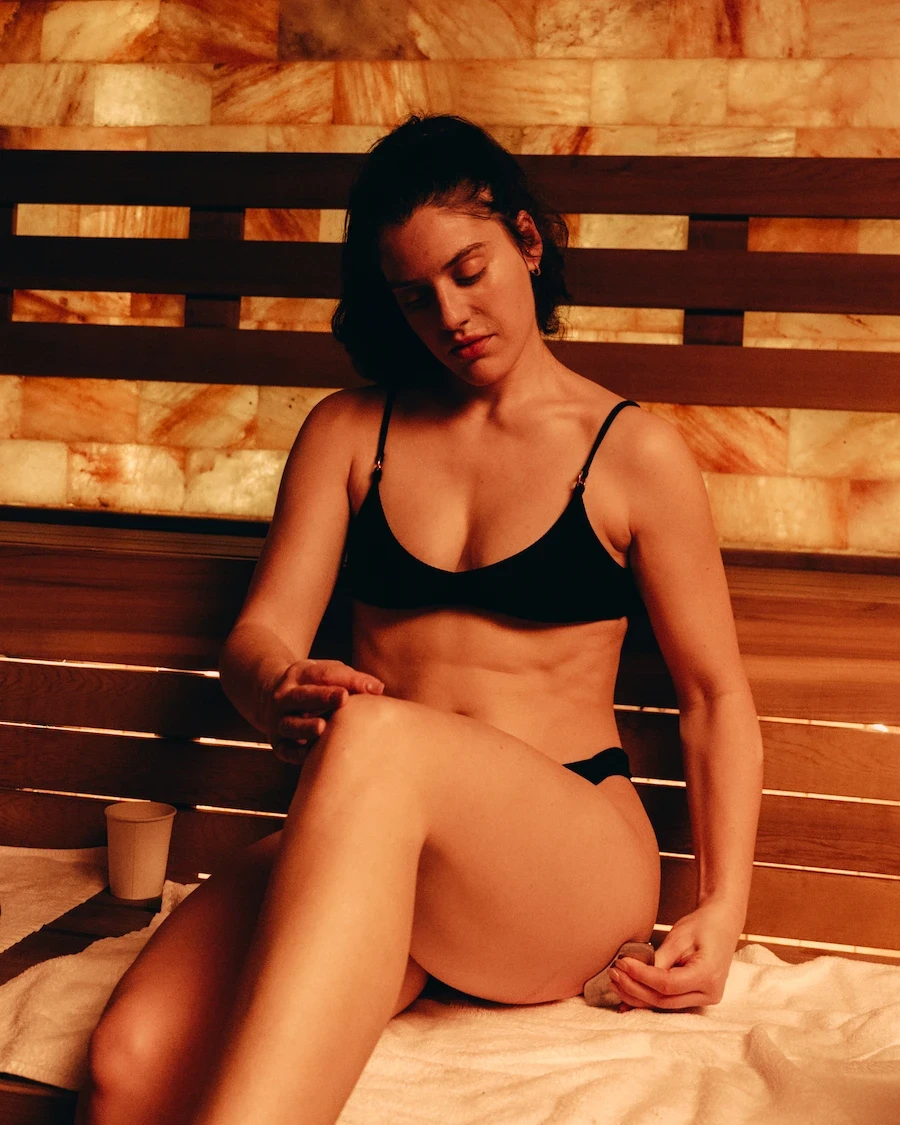
AetherHaus is built around this exact rhythm. A Himalayan salt sauna and group cold pools, with room to move between them at your own pace during a free-flow session.
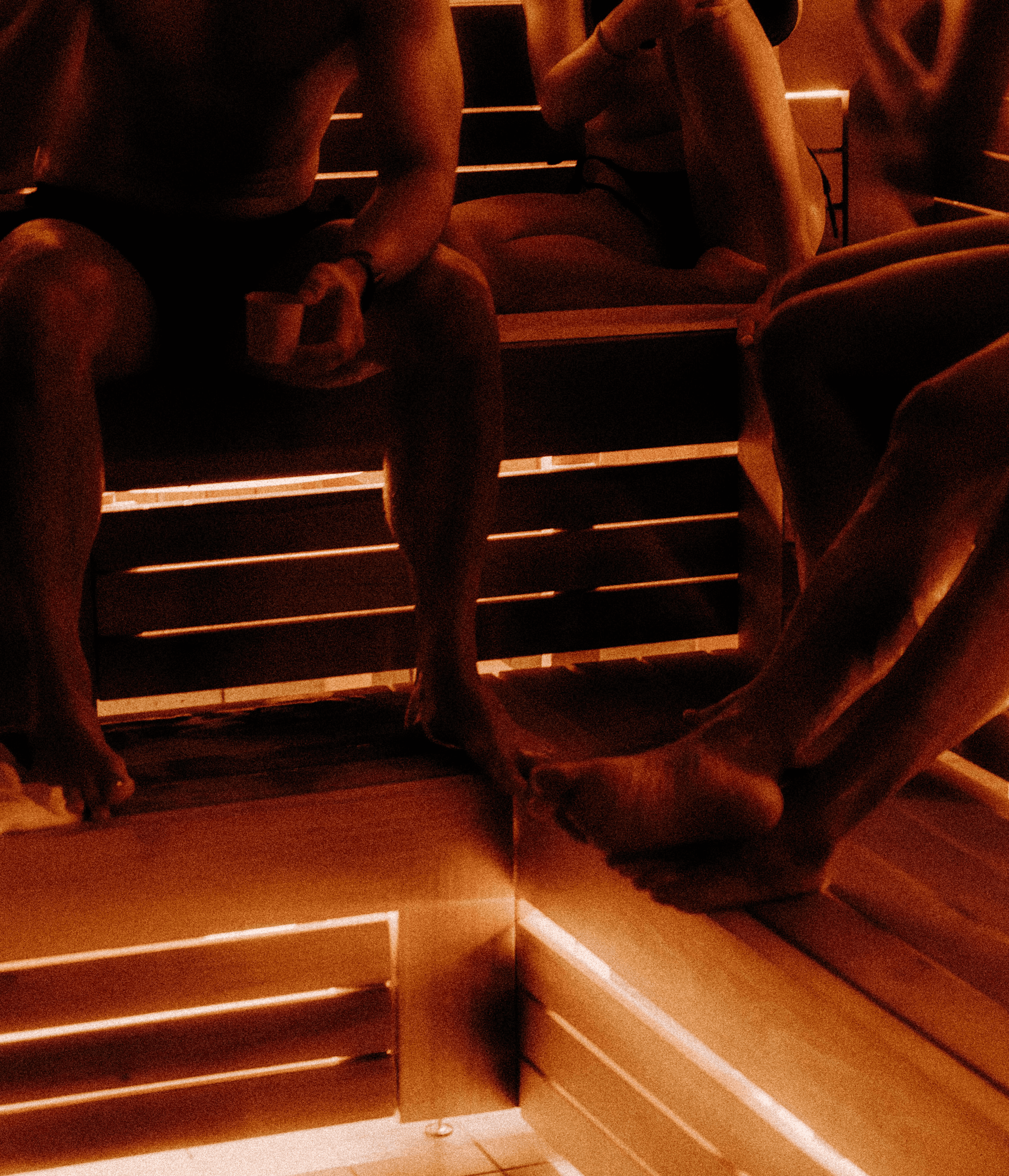
Nobody is timing you. You warm up, you plunge when you are ready, you rest, and you go again if you want to. Our guides keep the room workable and are there if you want a hand easing into the cold for the first time. If you would rather move through it with scent, steam, and music, our Aufguss sessions carry the same heat-then-cold arc inside a guided ritual.
Phones away. Clocks out of sight. The order is simple. The point is to come back to your body.
Key Takeaways
• For almost everyone, the order is sauna first, cold plunge second. Warm through, then finish cold
• Heat opens the body and has the strongest long-term research behind it (JAMA Internal Medicine, 2015)
• Cold tightens the body and helps with recovery, though the evidence is younger and more mixed (PubMed, 2016)
• End on cold to feel alert, end on heat to wind down for sleep
• Forget the stopwatch. Rough ranges can help, but your body sets the pace, not a timer
Want to feel the rhythm for yourself? Book a session at AetherHaus.
Frequently Asked Questions
Should you sauna or cold plunge first?
Sauna first. Warm the body fully in the heat, then finish in the cold plunge. This heat-then-cold order is the traditional Nordic cycle, and it gives your body somewhere to travel from when you hit the cold. Starting cold, before you are warm, tends to just make you tense.
How long should you wait between sauna and cold plunge?
Not long. Most people step from the sauna into the cold while still warm, once the heat has properly settled in. If you feel lightheaded, take a moment to steady your breathing first. The point is to move from hot to cold while the heat is still in you, not to hit a specific time.
Can you start with a cold plunge?
You can, but for most goals it is not ideal. Cold first constricts your vessels before the heat has opened them, so you miss most of the contrast effect. The exception is a very short cold dip to wake up before a warm-up, which some people like. As a full practice, warm first.
How many rounds of sauna and cold plunge should you do?
Two or three rounds is plenty for most people, though the honest answer is however many still feel good. More is not better. Listen to your body and stop when you feel done rather than chasing a number.
Cold plunge before or after a workout?
It depends on your aim. Cold after a workout can ease soreness and help you recover, while heavy cold immediately after strength training may blunt some muscle gains. There is more in our pieces on cold plunge and sauna for athletes and the benefits of sauna after a workout.
Is contrast therapy safe?
For most healthy adults, yes, when done in sensible sessions with rest and hydration. The swing between hot and cold does put a load on your heart, so anyone with a cardiovascular condition, low blood pressure, or a pregnancy should talk to a healthcare provider before starting.
Does AetherHaus have both a sauna and a cold plunge?
Yes. AetherHaus is built around a traditional Himalayan salt sauna and group cold pools, so the full hot-to-cold cycle happens in one space. You move between them at your own pace during a session, with guides on hand if you want them.
Step Into the Practice
Reading about the order is one thing. Feeling the swing from a hot sauna into cold water is another.
At AetherHaus, heat and cold are approached the way they have been for centuries. Slowly, without a stopwatch, in good company. Whether it is your first plunge or your hundredth, every session meets you where you are.
Book a session and find your rhythm.
In almost every case, sauna first and cold plunge second. Warm the body all the way through, then finish in the cold. This is the order Nordic and banya cultures settled on centuries ago, and modern research has not found a good reason to argue with it. The main exception is if your goal is to wind down for sleep, where finishing warm can suit you better. Less a rigid rule, more a rhythm your body already understands.
At AetherHaus, the whole space is built around this rhythm. Hot sauna, group cold pools, rest, repeat. Our practice draws on the old contrast therapy traditions, where the swing between heat and cold is the point, not a trend to optimise.
These are practices, not products. The order that matters most is the one you will actually keep coming back to.
The Short Answer: Sauna First, Cold Second
Start in the sauna. Let the heat work all the way through you until you feel it settle. Then step into the cold plunge for a short, sharp finish. Rest, and go again if you want another round.
This heat-then-cold sequence is often called the Nordic cycle. It has been the backbone of Finnish sauna and Russian banya practice for a very long time, and it is the pattern most people mean when they talk about contrast therapy.
Why Heat Then Cold Works
The order is not arbitrary. Each step sets up the next one.
What the Sauna Does First
The heat opens your blood vessels, relaxes your muscles, and raises your heart rate in a slow, steady way. Your body warms from the core outward, and everything loosens.
This is not just a nice feeling. The long-term research on traditional sauna is some of the most consistent in the field. In a 20-year Finnish study, people who used a sauna four to seven times a week had a 50 percent lower risk of fatal cardiovascular disease than once-a-week users (JAMA Internal Medicine, 2015). Our view: the heat is doing real work long before you ever touch the cold, so give it the time it asks for rather than rushing to the plunge.
What the Cold Plunge Does After
The cold does the opposite. Your blood vessels tighten, your breathing catches, and your attention snaps into the present. It is bracing on purpose.
On the research side, cold water immersion has been shown to help ease muscle soreness after hard exercise (PubMed, 2016), and to help the body settle back down faster after intense effort (PubMed, 2009). Our view: the evidence for cold is younger and more mixed than the evidence for heat, so we hold it lightly. What we can say for certain is how people feel walking out. Clear, awake, and a little more themselves.
The Contrast Is the Point
Going from hot to cold makes your vessels widen and then tighten in quick succession. That back-and-forth is the whole idea behind contrast therapy, and it is why the two together feel like more than the sum of a hot room and a cold pool.
Warm first means your body has somewhere to travel from. Cold first, before you are warm, skips that and mostly just makes you tense.
The One Time to Finish on Heat
There is a real exception, and it comes down to what you want afterward.
Ending on cold leaves you alert and switched on, which is why it suits a morning practice or a recovery session before the rest of your day. Ending on heat leaves you soft and drowsy, which is better if you are practising in the evening and want to sleep well.
So the honest read is: end cold to wake up, end warm to wind down. Your goal picks the finish, not a chart.
How Long, How Cold, How Many Rounds
Here is where most guides hand you a stopwatch and a chart. We are not going to. A session you spend counting minutes is a session you spend in your head instead of your body, and that is the opposite of the point.
If you want rough edges to feel for rather than targets to hit: a round of heat usually lasts until the warmth has properly settled in, and a cold plunge is much shorter, from a few slow breaths to a couple of minutes. Two or three rounds tends to be plenty. New to the cold? A short dip is a full session on its own.
Our view: hold all of that loosely. Your body knows when the heat has done its work and when the cold has, long before a timer does. Stay until you feel it land, and leave before you are gritting your teeth through it. Dizziness, a headache, or hands gone numb mean you are done for the day, whatever the clock says. There is more in our guide to your first cold plunge and to how long to stay in a sauna.
What the Research Supports
The short version: the heat has the deeper evidence, the cold has the fresher evidence, and the order has centuries of practice behind it.
The strongest long-term findings, including lower cardiovascular and dementia risk, come from traditional sauna populations (JAMA Internal Medicine, 2015). The cold research points toward real recovery benefits, with results that vary by person and by how it is used (PubMed, 2016).
Our view: the traditions worked the order out long before anyone measured it. The studies are slowly catching up to what people who practise this already know in their bodies. We follow the research where it helps, and we trust the tradition where the research has not caught up yet.
How AetherHaus Approaches This
AetherHaus is built around this exact rhythm. A Himalayan salt sauna and group cold pools, with room to move between them at your own pace during a free-flow session.
Nobody is timing you. You warm up, you plunge when you are ready, you rest, and you go again if you want to. Our guides keep the room workable and are there if you want a hand easing into the cold for the first time. If you would rather move through it with scent, steam, and music, our Aufguss sessions carry the same heat-then-cold arc inside a guided ritual.
Phones away. Clocks out of sight. The order is simple. The point is to come back to your body.
Key Takeaways
• For almost everyone, the order is sauna first, cold plunge second. Warm through, then finish cold
• Heat opens the body and has the strongest long-term research behind it (JAMA Internal Medicine, 2015)
• Cold tightens the body and helps with recovery, though the evidence is younger and more mixed (PubMed, 2016)
• End on cold to feel alert, end on heat to wind down for sleep
• Forget the stopwatch. Rough ranges can help, but your body sets the pace, not a timer
Want to feel the rhythm for yourself? Book a session at AetherHaus.
Frequently Asked Questions
Should you sauna or cold plunge first?
Sauna first. Warm the body fully in the heat, then finish in the cold plunge. This heat-then-cold order is the traditional Nordic cycle, and it gives your body somewhere to travel from when you hit the cold. Starting cold, before you are warm, tends to just make you tense.
How long should you wait between sauna and cold plunge?
Not long. Most people step from the sauna into the cold while still warm, once the heat has properly settled in. If you feel lightheaded, take a moment to steady your breathing first. The point is to move from hot to cold while the heat is still in you, not to hit a specific time.
Can you start with a cold plunge?
You can, but for most goals it is not ideal. Cold first constricts your vessels before the heat has opened them, so you miss most of the contrast effect. The exception is a very short cold dip to wake up before a warm-up, which some people like. As a full practice, warm first.
How many rounds of sauna and cold plunge should you do?
Two or three rounds is plenty for most people, though the honest answer is however many still feel good. More is not better. Listen to your body and stop when you feel done rather than chasing a number.
Cold plunge before or after a workout?
It depends on your aim. Cold after a workout can ease soreness and help you recover, while heavy cold immediately after strength training may blunt some muscle gains. There is more in our pieces on cold plunge and sauna for athletes and the benefits of sauna after a workout.
Is contrast therapy safe?
For most healthy adults, yes, when done in sensible sessions with rest and hydration. The swing between hot and cold does put a load on your heart, so anyone with a cardiovascular condition, low blood pressure, or a pregnancy should talk to a healthcare provider before starting.
Does AetherHaus have both a sauna and a cold plunge?
Yes. AetherHaus is built around a traditional Himalayan salt sauna and group cold pools, so the full hot-to-cold cycle happens in one space. You move between them at your own pace during a session, with guides on hand if you want them.
Step Into the Practice
Reading about the order is one thing. Feeling the swing from a hot sauna into cold water is another.
At AetherHaus, heat and cold are approached the way they have been for centuries. Slowly, without a stopwatch, in good company. Whether it is your first plunge or your hundredth, every session meets you where you are.
Book a session and find your rhythm.
our Blog
our Blog
More insights
More insights
Explore more reflections, guidance, and practical tools to support you.
Explore more reflections, guidance, and practical tools to support you.
A bathhouse sells entry to shared rooms. A spa sells a booked treatment. Here is what separates them, and which one suits your next visit.
You have probably seen both by now. One is a wood-lined room with a stove and a bed of stones. The other is a glass cabin with panels that glow. They both make you hot and both make you sweat, but they get there in completely different ways. Most guides will tell you which one is better. The more honest answer is that it depends on what your body responds to and what you actually want from the practice.
You have probably seen both by now. One is a wood-lined room with a stove and a bed of stones. The other is a glass cabin with panels that glow. They both make you hot and both make you sweat, but they get there in completely different ways. Most guides will tell you which one is better. The more honest answer is that it depends on what your body responds to and what you actually want from the practice.
Your questions.
Answered.
Not sure what to expect? These answers might help you feel more confident as you begin.
Didn’t find your answer? Send us a message, we’ll respond with care and clarity.
What is a modern bathhouse?
A modern bathhouse keeps the architecture of the old idea, hot room, cold water, somewhere to rest, and lets the rhythm of the city around it shape the rest. Ours is built for Vancouver, on Davie Street, in the West End.
What is a modern bathhouse?
A modern bathhouse keeps the architecture of the old idea, hot room, cold water, somewhere to rest, and lets the rhythm of the city around it shape the rest. Ours is built for Vancouver, on Davie Street, in the West End.
Is the cold plunge at your bathhouse communal?
Is the cold plunge at your bathhouse communal?
Yes. Our cold pools are shared, with multiple temperature options so you can find one that meets you where you are. Communal plunging is part of what makes a bathhouse a bathhouse.
Is the bathhouse a welcoming space for the queer community?
Is the bathhouse a welcoming space for the queer community?
Yes. The West End is home to us and to our queer neighbours, and the bathhouse is built for everyone who walks in. We also host queer nights on a regular rotation, which you can find on the Classes calendar.
What's the etiquette inside the bathhouse?
What's the etiquette inside the bathhouse?
Phones stay in lockers. Voices stay low. Sit or lie on a towel inside the sauna, move at your own pace between rooms, and leave the space the way you'd want to find it. The room works because everyone in it is paying a little attention.
Do you offer Russian Banya at the bathhouse?
Do you offer Russian Banya at the bathhouse?
We run banya-inspired programming including venik work on select dates. The full ritual has its own page if you want to read about it before you book.
Do I need to book ahead, or can I walk in?
Do I need to book ahead, or can I walk in?
Walk-ins are welcome based on availability, but most guests book ahead through our app or website to lock in their preferred session time.
Your questions.
Answered.
Not sure what to expect? These answers might help you feel more confident as you begin.
What do I need to bring?
Please bring a bathing suit and a reusable water bottle. We provide two towels per guest, shower products, and secure lockers.
What do I need to bring?
Please bring a bathing suit and a reusable water bottle. We provide two towels per guest, shower products, and secure lockers.
Do I need a reservation?
Do I need a reservation?
Walk-ins are welcome, but we recommend booking through our app or website to check availability and join the waitlist.
Where can I park?
Where can I park?
Street parking is limited. We offer valet parking behind AetherHaus from 11:00–23:00. There is also some street parking available on Davie and nearby side streets.
What is Open Haus?
What is Open Haus?
Open Haus is a self-guided circuit through our saunas, plunge pools, and tea lounge. Our guides add essential oils to the stove throughout the day. The atmosphere shifts between silent, casual, and social, depending on the session.
What is your Haus Etiquette?
What is your Haus Etiquette?
Phones must be stored away. Please keep conversation soft, sit or lie on a towel, and move mindfully through the space. We ask that guests respect others’ experience and refrain from bringing outside food or drinks - complimentary tea is provided.
Can I visit if I am pregnant?
Can I visit if I am pregnant?
We advise against hot and cold therapy during pregnancy unless approved by your healthcare provider.
Didn’t find your answer? Send us a message, we’ll respond with care and clarity.
Your questions.
Answered.
Not sure what to expect? These answers might help you feel more confident as you begin.
Didn’t find your answer? Send us a message, we’ll respond with care and clarity.
What is a modern bathhouse?
A modern bathhouse keeps the architecture of the old idea, hot room, cold water, somewhere to rest, and lets the rhythm of the city around it shape the rest. Ours is built for Vancouver, on Davie Street, in the West End.
What is a modern bathhouse?
A modern bathhouse keeps the architecture of the old idea, hot room, cold water, somewhere to rest, and lets the rhythm of the city around it shape the rest. Ours is built for Vancouver, on Davie Street, in the West End.
Is the cold plunge at your bathhouse communal?
Is the cold plunge at your bathhouse communal?
Yes. Our cold pools are shared, with multiple temperature options so you can find one that meets you where you are. Communal plunging is part of what makes a bathhouse a bathhouse.
Is the bathhouse a welcoming space for the queer community?
Is the bathhouse a welcoming space for the queer community?
Yes. The West End is home to us and to our queer neighbours, and the bathhouse is built for everyone who walks in. We also host queer nights on a regular rotation, which you can find on the Classes calendar.
What's the etiquette inside the bathhouse?
What's the etiquette inside the bathhouse?
Phones stay in lockers. Voices stay low. Sit or lie on a towel inside the sauna, move at your own pace between rooms, and leave the space the way you'd want to find it. The room works because everyone in it is paying a little attention.
Do you offer Russian Banya at the bathhouse?
Do you offer Russian Banya at the bathhouse?
We run banya-inspired programming including venik work on select dates. The full ritual has its own page if you want to read about it before you book.
Do I need to book ahead, or can I walk in?
Do I need to book ahead, or can I walk in?
Walk-ins are welcome based on availability, but most guests book ahead through our app or website to lock in their preferred session time.