Banya vs Sauna: When Steam Becomes Ritual (And Why Timing Your Sweat Misses the Point)
Banya vs Sauna: When Steam Becomes Ritual (And Why Timing Your Sweat Misses the Point)
The question is not which is better. The question is: what are you looking for when you step into heat?
The question is not which is better. The question is: what are you looking for when you step into heat?
Published on:
Published on:
Russian banya and Finnish sauna represent two ancient paths to the same destination - your body's natural ability to reset through temperature contrast. Banya embraces wet heat at 60-70°C with humidity levels reaching 40-70% (Banya No.1 Chiswick, 2024). Finnish saunas prefer dry intensity at 80-100°C with humidity dropping to just 5-15% (Banya No.1 Chiswick, 2024). One invites communion through steam and birch branches. The other offers contemplation through silence and crackling wood.
But somewhere between Finland and Russia and their eventual arrival in Vancouver, these traditions encountered something that threatens to drain them of meaning: the optimization mentality. The timer. The protocol. The tracking app.
This is not about that.
Banya and Sauna: Two Ancient Heat Traditions
Where Finnish Sauna Began
Finnish sauna culture reaches back approximately 7,000 BC, making it one of humanity's oldest continuous practices (National Geographic, 2024). In December 2020, UNESCO recognized Finnish sauna culture on its Intangible Cultural Heritage List (UNESCO, 2020).
The numbers tell a story about cultural ubiquity: Finland maintains 3.3 million saunas for 5.5 million people (UNESCO, 2020). Almost 90% of Finns take a sauna at least once a week (National Geographic, 2024).
The Finnish word löyly originally meant "spirit, breath, soul" in Uralic languages (Wikipedia, 2024). It describes the sacred steam released when water meets hot stones. Finns have traditionally considered the sauna a "church of nature", a sacred space for cleansing the body and mind (UNESCO, 2020).
The Russian Banya Heritage
Early descriptions of banya appear in the East Slavic Primary Chronicle of 1113, documenting Apostle Andrew's observations of Slavic bathing practices (Wikipedia, 2024). The banya born in Kievan Rus' absorbed bathing traditions from Byzantium, Finnish influences, Jewish communities, and Khazar tribes (Wikipedia, 2024).
Russians have always associated banya with relaxation and socializing. It is fundamentally a communal experience of friendship and openness (Banya No.1 Chiswick, 2024).
The distinction matters less than understanding what each tradition offers your nervous system in the moment you need it.
How German Aufguss Joined the Conversation
German soldiers experienced Finnish saunas during WWII and brought the custom back to Germany, where it flourished in the second half of the 20th century (Wikipedia, 2024). The Germans did not simply copy the Finnish approach.
They made it their own.
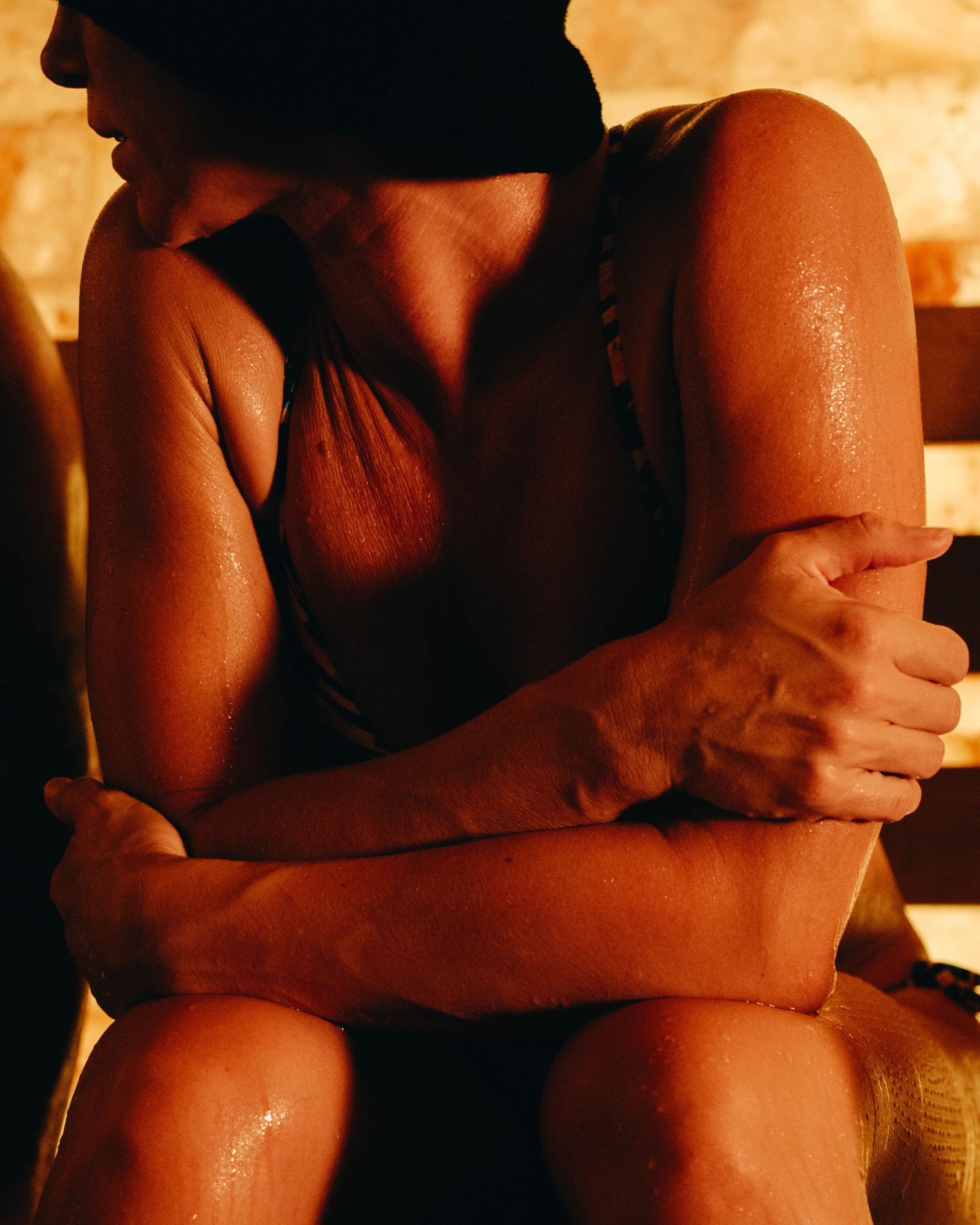
Aufgus, German for "infusion", involves pouring essential oil-infused water onto hot sauna stones while an Aufgussmeister uses rhythmic towel movements to distribute aromatic steam (Aaru Collective, 2025). The practice originated from a practical need to re-oxygenate enclosed sauna spaces after heavy sweating (Nordik Spa Village, 2021).
What began as simple air circulation evolved into complex choreography incorporating essential oils, music, lighting, and storytelling (Well + Good Travel, 2025). Over 30 million Germans now use saunas regularly (Sauna with Alex, 2019).
At AetherHaus in Vancouver's West End, these three traditions converge under one roof. Russian banya rituals meet German aufguss theatre and Nordic contemplation. The Himalayan salt sauna holds space for all three approaches.
Heat, Humidity, and the Science of Steam
The technical differences between banya and sauna create distinct physiological experiences.
Temperature and Moisture Profiles
Tradition | Temperature | Humidity | Heat Character |
Russian Banya | 60-70°C (140-158°F) | 40-70% | Wet, enveloping steam |
Finnish Sauna | 80-100°C (176-212°F) | 5-15% | Dry, penetrating heat |
German Aufguss | 80-95°C (176-203°F) | Variable spikes | Theatrical steam waves |
Finnish researchers found the most comfortable banya range sits at 40-65°C with 40-60% humidity (Morzh). Yet banya temperatures can exceed 93°C, requiring felt hats to protect the head from intense heat (Wikipedia, 2024).
What Your Body Experiences
High humidity in banya prevents sweat from evaporating quickly. Your skin stays wet. The heat feels gentler but penetrates deeper. The steam wraps around you like a blanket.
Dry heat in Finnish saunas allows rapid sweat evaporation. Your skin cools itself more efficiently. The air feels sharper. You can tolerate higher temperatures because your body's cooling mechanism works freely.
Neither is superior. They ask different things of your nervous system.
When I started cold exposure after my ankylosing spondylitis diagnosis, I was desperate to find anything that would decrease my pain. I was in my mid-20s, unable to walk some mornings, watching my dad's spine fuse into a hunchback position from the same autoimmune condition.
The Wim Hof Method taught me that duration does not matter. Sensation matters. Some days I stayed in ice water briefly. Other days, longer felt right. My body told me when to exit, not a timer.
The same principle applies to heat. Your nervous system knows what it needs today. The question is whether you are listening.
The Ritual Elements: From Venik to Silence
The Venik: Birch Branches as Medicine
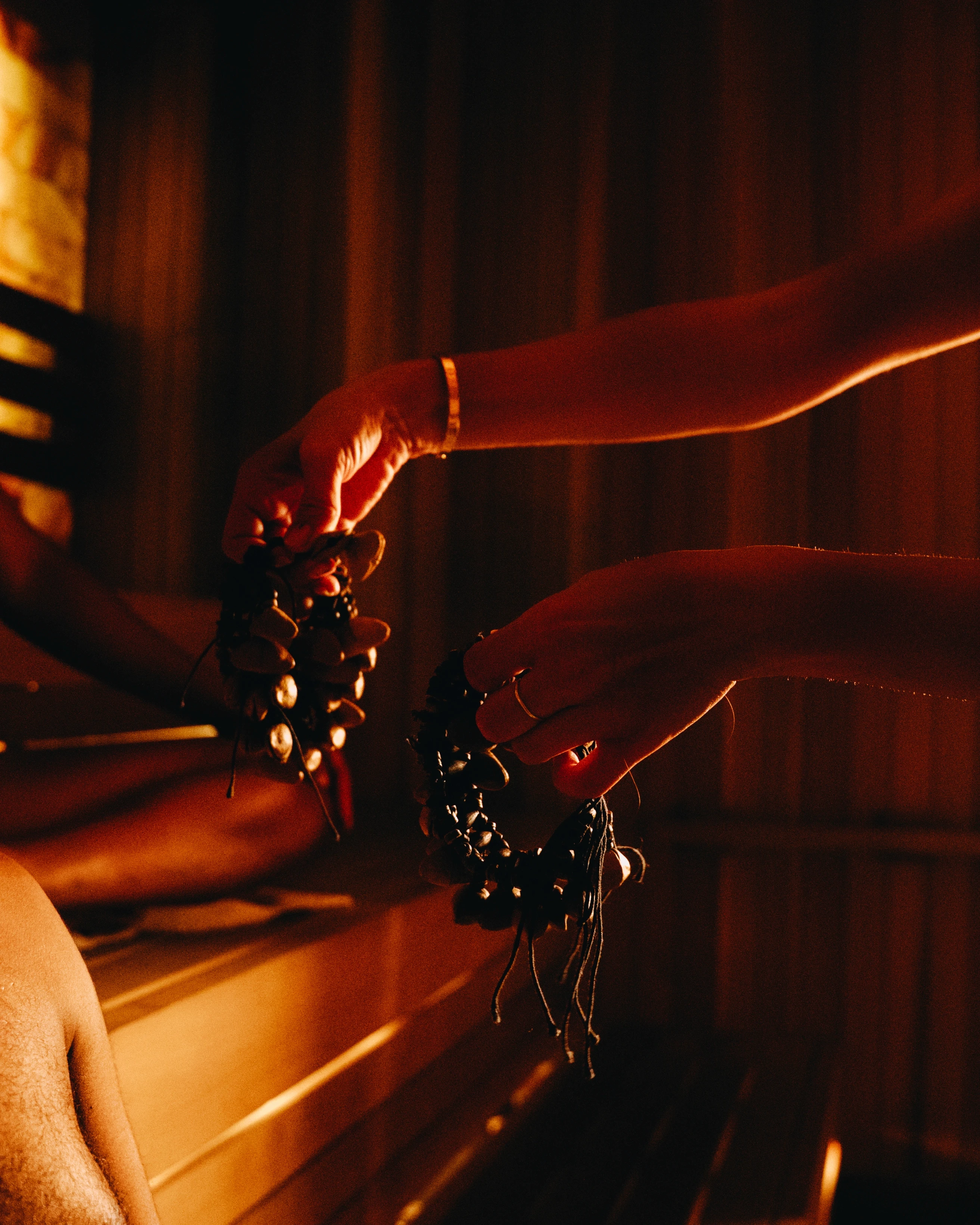
The venik defines Russian banya culture. These bundles of birch, oak, or eucalyptus branches are soaked in water then used to massage the body in rhythmic sweeping motions.
Birch venik leaves contain oils with antibacterial, anti-inflammatory, and anti-viral properties (Banya No.1 Chiswick, 2024). The leaves carry vitamins A and C, essential oils, and tannins that cleanse skin and relieve muscle pain (STPGoods).
Venik massage stimulates blood circulation and promotes lymphatic drainage, helping alleviate muscle tension (Banya Athens, 2025). Oak venik is rich in tannins with skin-firming and anti-aging effects, creating a calming effect on the nervous system (Banya Athens, 2025).
The treatment is called parenie, one of the oldest bathhouse massage practices, predominantly a massage of hot steam using leafy branches (Banya No.1 Chiswick, 2024).
There is no prescribed number of strokes. No optimal duration. The banshchik (banya attendant) reads your body's signals and adjusts accordingly.
Finnish Sauna: The Church of Silence
The Finnish sauna is meditation. It is a time for storing phones away, disconnecting from the digital world, and being present (National Geographic, 2024).
You sit. You sweat. You listen to wood crackle. Occasionally someone ladles water onto stones. The resulting steam—löyly—rises and spreads. Then silence returns.
This is not anti-social. It is pre-social. You must meet yourself before you can genuinely meet others.
At AetherHaus, our Silent Open Haus sessions honour this tradition. No phones. No clocks. No conversation unless it emerges naturally from shared presence.
German Aufguss: Theatre Meets Tradition
Aufguss transformed the practical into the performative. The Aufgussmeister becomes choreographer, aromatherapist, and storyteller simultaneously.
Essential oils infuse the water. Music builds atmosphere. Towel movements create waves of scented steam that wash over participants in rhythmic pulses. Some aufguss sessions follow narrative arcs—journeys through seasons, elements, or emotional landscapes.
Our Aufguss ritual at AetherHaus draws on this German tradition while incorporating Eastern European sensibilities. We perform it in darkness, shifting from performance to introspection. Psychedelic-inspired music replaces typical spa soundscapes. The experience cycles through stillness, challenge, release, and emotion.
The question people rarely ask: why did Germans theatricalize what Finns kept contemplative?
Perhaps because different nervous systems need different invitations to let go.
Communion or Contemplation: The Social Nature of Heat
Banya as Communal Ground
Russians view banya as fundamentally social. You bring friends. You bring family. You bring strangers who become friends through shared vulnerability.
The high humidity softens boundaries between bodies. Everyone sweats together. The venik massage happens in front of others. There is no privacy in steam, and that becomes the point.
After eight months of consistent cold exposure practice, I noticed something beyond the physical changes. My pain decreased. My energy stabilized. But what surprised me most was how the practice changed my relationship with discomfort in the presence of others.
Chronic pain can make you isolated. You hide your limitations. You perform normalcy while your body screams.
The communal aspect of heat and cold work breaks that isolation. Everyone in the room is vulnerable. Everyone is navigating their edge. That shared uncertainty creates different possibilities for connection.
Finnish Sauna as Inward Journey
Finnish sauna culture accommodates both solitude and company, but the default orientation is inward. Conversation happens, but it emerges from silence rather than filling it.
You are not performing. You are not entertaining. You are simply present with heat and breath and the sound of your own heartbeat slowing down.
Many find this confronting at first. Without distraction, you meet what you have been avoiding. But that confrontation is the work.
At AetherHaus, we offer both paths. Social Open Haus encourages connection and community. Silent Open Haus protects solitude. Neither is more authentic than the other.
The question is not which tradition is correct. The question is which invitation your nervous system needs today.
What Your Body Experiences in Heat and Cold
The Circulation Response
Alternating between heat and cold creates dramatic vascular effects. Heat causes vasodilation, blood vessels expand, increasing blood flow to the skin (Healthprem, 2024). Cold triggers vasoconstriction—vessels narrow, pushing blood toward your core.
This alternating expansion and contraction functions like a cardiovascular workout. Your circulatory system learns to regulate more efficiently.
Athletic Recovery and Inflammation
A 2017 study found that alternating between hot saunas and cold plunge tubs helped team sports players recover from fatigue quickly (RENU Therapy). Cold exposure causes vasoconstriction which flushes out released toxins and decreases swelling, relieving lactic acid accumulation (Plunsana, 2025).
Our Pilates & Plunge sessions apply this principle directly. Pilates in heat challenges your body. The subsequent cold plunge and free-flow time allows integration and recovery.
Immune System Activation
Elevated body temperature from sauna helps certain types of immune cells function better, potentially keeping users from falling sick (Plunge).
The mechanism is not magical. Your body learns to regulate stress response more efficiently. That efficiency extends to immune function.
The Nervous System Reset
This is where the research intersects with lived experience in ways that numbers cannot fully capture.
Contrast therapy trains your nervous system to navigate between sympathetic activation (fight-or-flight) and parasympathetic restoration (rest-and-digest). You learn to stay present with intensity. You learn to truly rest when rest is available.
For people navigating chronic conditions, chronic stress, or chronic pain, this training becomes foundational. Your body remembers that regulation is possible.
The benefits compound over time. But these practices do not need to become another thing you are "doing right" or tracking in an app.
Which Practice Calls to You?
Choose Banya If You Are Seeking
Communal experience where vulnerability becomes connection
Gentle heat that wraps around you rather than challenging you
Venik massage and the sensation of birch branches on skin
Cultural ritual with specific ceremonial elements
Social restoration where conversation flows naturally with steam
Choose Aufguss If You Are Seeking
An experience that engages multiple senses
Guided journey through heat, aroma, and choreography
Community ritual with performative elements
Sensory immersion beyond simple temperature exposure
Emotional release through structured intensity
At AetherHaus, you do not need to choose permanently. Our space honours all three traditions. You can experience yin yoga in the Himalayan salt sauna one week and attend an aufguss ritual the next.
For First-Timers: What Your Body Will Tell You
There is no perfect way to begin. Your body will guide you if you listen.
Start with shorter exposures. Exit when your body signals; a slight headache, dizziness, or feeling overwhelmed means it is time to leave. This is not failure. This is your nervous system establishing its current capacity.
Move between hot and cold slowly at first. Some people need weeks or months before cold exposure feels approachable. Others dive in immediately. Neither path is superior.
The duration matters less than the quality of your attention during the experience. Genuine presence outweighs distracted endurance.
Bring a reusable water bottle. Wear a swimsuit. Leave your phone and watch behind. Everything else will reveal itself.
Our guide to your first cold plunge offers more detailed preparation suggestions.
Beyond the Binary: When Traditions Merge
The banya versus sauna question assumes you must choose sides. But these traditions share more than they differ.
Both recognize that humans need regular temperature stress to maintain resilience. Both understand that heat creates threshold experiences that change your relationship with discomfort. Both honour the transition from heat to cold to rest as sacred sequence.
At AetherHaus on Davie Street in Vancouver's West End, we bring Russian banya traditions, German aufguss theatre, and Nordic sauna contemplation together. Our Himalayan salt sauna adds another dimension, mineral-infused heat that Eastern European banya culture would recognize immediately.
We also bring contrast therapy, breathwork, movement practices like Pilates, and meditation. These modalities layer on top of ancient heat traditions to create something that belongs to this specific place and time.
The Question No One Asks
Why are we timing our sweat?
When did the felt hat in Russian banya, originally worn so you could stay longer without overheating, become a performance metric? When did the Finnish tradition of sitting until you naturally feel ready to exit become "optimal sauna duration"?
The modern optimization mindset transforms ritual into protocol. It reduces embodied wisdom to numbers in an app. It asks "how long should I stay" instead of "what is my body telling me right now?"
Both banya and sauna offer an alternative. They remind us that our bodies know how to regulate themselves if we create the right conditions and then get out of the way.
There is no perfect duration. Your body will tell you when it is time. Some days, brief immersion in cold water is enough. Other days, you float longer and emerge transformed. The difference is not in your timer but in your nervous system's capacity in that specific moment.
After practicing consistently—after getting off immunosuppressant medication, after years without chronic pain, after teaching workshops and leading retreats and guiding hundreds of people through their first cold exposure—I still do not time my sessions.
I feel. I stay present. I exit when my body signals completion.
This is not about optimization. It is about presence.
Frequently Asked Questions
What is the main difference between banya and sauna?
Banya uses moderate temperatures (60-70°C) with high humidity (40-70%), creating wet, enveloping steam (Banya No.1 Chiswick, 2024). Finnish sauna uses higher temperatures (80-100°C) with very low humidity (5-15%), creating dry, penetrating heat (Banya No.1 Chiswick, 2024). Banya emphasizes communal experience with venik massage rituals, while Finnish sauna traditionally centres on contemplative silence.
Is banya better than sauna for health?
Both practices offer similar cardiovascular, immune, and recovery benefits through temperature contrast. The "better" choice depends on your nervous system's needs and personal preferences. Banya's gentler heat may be more accessible for beginners or those with heat sensitivity. Finnish sauna's intense dry heat can feel more meditative for experienced practitioners. Consistent practice with either tradition produces meaningful results.
What is a venik and how is it used?
A venik is a bundle of birch, oak, or eucalyptus branches used in Russian banya for massage. The branches are soaked in water then used to create rhythmic sweeping motions across the body. Birch venik contains anti-inflammatory oils, vitamins A and C, and tannins that cleanse skin and relieve muscle pain (Banya No.1 Chiswick, 2024). The massage stimulates circulation and lymphatic drainage (Banya Athens, 2025).
Why do people wear felt hats in banya?
Felt or wool hats protect the head from overheating in high-temperature banya environments. Since heat rises, your head experiences the hottest temperatures in the steam room. The hat allows you to remain in the banya longer without discomfort, following sensation rather than forcing endurance (Banya No.1 Chiswick, 2024).
How long should I stay in banya versus sauna?
Duration should follow sensation, not prescription. Your body signals when it is time to exit through subtle cues; slight dizziness, overwhelm, or natural completion. Some sessions last briefly. Others extend longer. The practice is learning to listen to these signals rather than following external protocols. Start with shorter exposures and build capacity gradually.
Can beginners safely try both banya and sauna?
Yes. Both practices accommodate beginners when approached with awareness. Start with lower temperatures and shorter durations. Exit immediately if you feel dizzy, nauseous, or overwhelmed. Move slowly between temperature extremes. Stay hydrated. Bring someone experienced with you for your first session. Your nervous system will establish its baseline capacity within the first few visits.
What is the difference between banya and Turkish hammam?
Banya uses higher temperatures (60-70°C) with moderate humidity and emphasizes contrast therapy between hot steam and cold plunge. Turkish hammam operates at lower temperatures (40-50°C) with very high humidity, focusing on extended relaxation and massage rather than temperature contrast. Hammam traditions include soap foam massage and full-body scrubbing, while banya centres on venik massage with birch branches.
How does German aufguss relate to banya and sauna?
Aufguss evolved from Finnish sauna traditions brought to Germany after WWII. Germans transformed the contemplative Finnish practice into theatrical performance, adding essential oils, choreographed towel movements, music, and narrative elements (Well + Good Travel, 2025). Aufguss shares banya's communal emphasis and sauna's high-heat foundation while creating its own distinct ritual language through multi-sensory immersion.
Key Takeaways
Russian banya (60-70°C, 40-70% humidity) creates gentle, communal steam experiences with venik massage rituals (Banya No.1 Chiswick, 2024)
Finnish sauna (80-100°C, 5-15% humidity) offers intense, meditative dry heat in silence, recognized by UNESCO as Intangible Cultural Heritage (UNESCO, 2020)
German aufguss evolved from practical air circulation into theatrical multi-sensory ritual incorporating essential oils, music, and choreography (Well + Good Travel, 2025)
Contrast therapy between heat and cold improves circulation, immune function, and athletic recovery. (RENU Therapy)
Duration should follow body sensation rather than prescribed protocols, your nervous system knows its capacity better than any timer
Experience Russian banya, German aufguss, and Nordic sauna traditions in one space. Book your first session at AetherHaus in Vancouver's West End.
Russian banya and Finnish sauna represent two ancient paths to the same destination - your body's natural ability to reset through temperature contrast. Banya embraces wet heat at 60-70°C with humidity levels reaching 40-70% (Banya No.1 Chiswick, 2024). Finnish saunas prefer dry intensity at 80-100°C with humidity dropping to just 5-15% (Banya No.1 Chiswick, 2024). One invites communion through steam and birch branches. The other offers contemplation through silence and crackling wood.
But somewhere between Finland and Russia and their eventual arrival in Vancouver, these traditions encountered something that threatens to drain them of meaning: the optimization mentality. The timer. The protocol. The tracking app.
This is not about that.
Banya and Sauna: Two Ancient Heat Traditions
Where Finnish Sauna Began
Finnish sauna culture reaches back approximately 7,000 BC, making it one of humanity's oldest continuous practices (National Geographic, 2024). In December 2020, UNESCO recognized Finnish sauna culture on its Intangible Cultural Heritage List (UNESCO, 2020).
The numbers tell a story about cultural ubiquity: Finland maintains 3.3 million saunas for 5.5 million people (UNESCO, 2020). Almost 90% of Finns take a sauna at least once a week (National Geographic, 2024).
The Finnish word löyly originally meant "spirit, breath, soul" in Uralic languages (Wikipedia, 2024). It describes the sacred steam released when water meets hot stones. Finns have traditionally considered the sauna a "church of nature", a sacred space for cleansing the body and mind (UNESCO, 2020).
The Russian Banya Heritage
Early descriptions of banya appear in the East Slavic Primary Chronicle of 1113, documenting Apostle Andrew's observations of Slavic bathing practices (Wikipedia, 2024). The banya born in Kievan Rus' absorbed bathing traditions from Byzantium, Finnish influences, Jewish communities, and Khazar tribes (Wikipedia, 2024).
Russians have always associated banya with relaxation and socializing. It is fundamentally a communal experience of friendship and openness (Banya No.1 Chiswick, 2024).
The distinction matters less than understanding what each tradition offers your nervous system in the moment you need it.
How German Aufguss Joined the Conversation
German soldiers experienced Finnish saunas during WWII and brought the custom back to Germany, where it flourished in the second half of the 20th century (Wikipedia, 2024). The Germans did not simply copy the Finnish approach.
They made it their own.
Aufgus, German for "infusion", involves pouring essential oil-infused water onto hot sauna stones while an Aufgussmeister uses rhythmic towel movements to distribute aromatic steam (Aaru Collective, 2025). The practice originated from a practical need to re-oxygenate enclosed sauna spaces after heavy sweating (Nordik Spa Village, 2021).
What began as simple air circulation evolved into complex choreography incorporating essential oils, music, lighting, and storytelling (Well + Good Travel, 2025). Over 30 million Germans now use saunas regularly (Sauna with Alex, 2019).
At AetherHaus in Vancouver's West End, these three traditions converge under one roof. Russian banya rituals meet German aufguss theatre and Nordic contemplation. The Himalayan salt sauna holds space for all three approaches.
Heat, Humidity, and the Science of Steam
The technical differences between banya and sauna create distinct physiological experiences.
Temperature and Moisture Profiles
Tradition | Temperature | Humidity | Heat Character |
Russian Banya | 60-70°C (140-158°F) | 40-70% | Wet, enveloping steam |
Finnish Sauna | 80-100°C (176-212°F) | 5-15% | Dry, penetrating heat |
German Aufguss | 80-95°C (176-203°F) | Variable spikes | Theatrical steam waves |
Finnish researchers found the most comfortable banya range sits at 40-65°C with 40-60% humidity (Morzh). Yet banya temperatures can exceed 93°C, requiring felt hats to protect the head from intense heat (Wikipedia, 2024).
What Your Body Experiences
High humidity in banya prevents sweat from evaporating quickly. Your skin stays wet. The heat feels gentler but penetrates deeper. The steam wraps around you like a blanket.
Dry heat in Finnish saunas allows rapid sweat evaporation. Your skin cools itself more efficiently. The air feels sharper. You can tolerate higher temperatures because your body's cooling mechanism works freely.
Neither is superior. They ask different things of your nervous system.
When I started cold exposure after my ankylosing spondylitis diagnosis, I was desperate to find anything that would decrease my pain. I was in my mid-20s, unable to walk some mornings, watching my dad's spine fuse into a hunchback position from the same autoimmune condition.
The Wim Hof Method taught me that duration does not matter. Sensation matters. Some days I stayed in ice water briefly. Other days, longer felt right. My body told me when to exit, not a timer.
The same principle applies to heat. Your nervous system knows what it needs today. The question is whether you are listening.
The Ritual Elements: From Venik to Silence
The Venik: Birch Branches as Medicine
The venik defines Russian banya culture. These bundles of birch, oak, or eucalyptus branches are soaked in water then used to massage the body in rhythmic sweeping motions.
Birch venik leaves contain oils with antibacterial, anti-inflammatory, and anti-viral properties (Banya No.1 Chiswick, 2024). The leaves carry vitamins A and C, essential oils, and tannins that cleanse skin and relieve muscle pain (STPGoods).
Venik massage stimulates blood circulation and promotes lymphatic drainage, helping alleviate muscle tension (Banya Athens, 2025). Oak venik is rich in tannins with skin-firming and anti-aging effects, creating a calming effect on the nervous system (Banya Athens, 2025).
The treatment is called parenie, one of the oldest bathhouse massage practices, predominantly a massage of hot steam using leafy branches (Banya No.1 Chiswick, 2024).
There is no prescribed number of strokes. No optimal duration. The banshchik (banya attendant) reads your body's signals and adjusts accordingly.
Finnish Sauna: The Church of Silence
The Finnish sauna is meditation. It is a time for storing phones away, disconnecting from the digital world, and being present (National Geographic, 2024).
You sit. You sweat. You listen to wood crackle. Occasionally someone ladles water onto stones. The resulting steam—löyly—rises and spreads. Then silence returns.
This is not anti-social. It is pre-social. You must meet yourself before you can genuinely meet others.
At AetherHaus, our Silent Open Haus sessions honour this tradition. No phones. No clocks. No conversation unless it emerges naturally from shared presence.
German Aufguss: Theatre Meets Tradition
Aufguss transformed the practical into the performative. The Aufgussmeister becomes choreographer, aromatherapist, and storyteller simultaneously.
Essential oils infuse the water. Music builds atmosphere. Towel movements create waves of scented steam that wash over participants in rhythmic pulses. Some aufguss sessions follow narrative arcs—journeys through seasons, elements, or emotional landscapes.
Our Aufguss ritual at AetherHaus draws on this German tradition while incorporating Eastern European sensibilities. We perform it in darkness, shifting from performance to introspection. Psychedelic-inspired music replaces typical spa soundscapes. The experience cycles through stillness, challenge, release, and emotion.
The question people rarely ask: why did Germans theatricalize what Finns kept contemplative?
Perhaps because different nervous systems need different invitations to let go.
Communion or Contemplation: The Social Nature of Heat
Banya as Communal Ground
Russians view banya as fundamentally social. You bring friends. You bring family. You bring strangers who become friends through shared vulnerability.
The high humidity softens boundaries between bodies. Everyone sweats together. The venik massage happens in front of others. There is no privacy in steam, and that becomes the point.
After eight months of consistent cold exposure practice, I noticed something beyond the physical changes. My pain decreased. My energy stabilized. But what surprised me most was how the practice changed my relationship with discomfort in the presence of others.
Chronic pain can make you isolated. You hide your limitations. You perform normalcy while your body screams.
The communal aspect of heat and cold work breaks that isolation. Everyone in the room is vulnerable. Everyone is navigating their edge. That shared uncertainty creates different possibilities for connection.
Finnish Sauna as Inward Journey
Finnish sauna culture accommodates both solitude and company, but the default orientation is inward. Conversation happens, but it emerges from silence rather than filling it.
You are not performing. You are not entertaining. You are simply present with heat and breath and the sound of your own heartbeat slowing down.
Many find this confronting at first. Without distraction, you meet what you have been avoiding. But that confrontation is the work.
At AetherHaus, we offer both paths. Social Open Haus encourages connection and community. Silent Open Haus protects solitude. Neither is more authentic than the other.
The question is not which tradition is correct. The question is which invitation your nervous system needs today.
What Your Body Experiences in Heat and Cold
The Circulation Response
Alternating between heat and cold creates dramatic vascular effects. Heat causes vasodilation, blood vessels expand, increasing blood flow to the skin (Healthprem, 2024). Cold triggers vasoconstriction—vessels narrow, pushing blood toward your core.
This alternating expansion and contraction functions like a cardiovascular workout. Your circulatory system learns to regulate more efficiently.
Athletic Recovery and Inflammation
A 2017 study found that alternating between hot saunas and cold plunge tubs helped team sports players recover from fatigue quickly (RENU Therapy). Cold exposure causes vasoconstriction which flushes out released toxins and decreases swelling, relieving lactic acid accumulation (Plunsana, 2025).
Our Pilates & Plunge sessions apply this principle directly. Pilates in heat challenges your body. The subsequent cold plunge and free-flow time allows integration and recovery.
Immune System Activation
Elevated body temperature from sauna helps certain types of immune cells function better, potentially keeping users from falling sick (Plunge).
The mechanism is not magical. Your body learns to regulate stress response more efficiently. That efficiency extends to immune function.
The Nervous System Reset
This is where the research intersects with lived experience in ways that numbers cannot fully capture.
Contrast therapy trains your nervous system to navigate between sympathetic activation (fight-or-flight) and parasympathetic restoration (rest-and-digest). You learn to stay present with intensity. You learn to truly rest when rest is available.
For people navigating chronic conditions, chronic stress, or chronic pain, this training becomes foundational. Your body remembers that regulation is possible.
The benefits compound over time. But these practices do not need to become another thing you are "doing right" or tracking in an app.
Which Practice Calls to You?
Choose Banya If You Are Seeking
Communal experience where vulnerability becomes connection
Gentle heat that wraps around you rather than challenging you
Venik massage and the sensation of birch branches on skin
Cultural ritual with specific ceremonial elements
Social restoration where conversation flows naturally with steam
Choose Aufguss If You Are Seeking
An experience that engages multiple senses
Guided journey through heat, aroma, and choreography
Community ritual with performative elements
Sensory immersion beyond simple temperature exposure
Emotional release through structured intensity
At AetherHaus, you do not need to choose permanently. Our space honours all three traditions. You can experience yin yoga in the Himalayan salt sauna one week and attend an aufguss ritual the next.
For First-Timers: What Your Body Will Tell You
There is no perfect way to begin. Your body will guide you if you listen.
Start with shorter exposures. Exit when your body signals; a slight headache, dizziness, or feeling overwhelmed means it is time to leave. This is not failure. This is your nervous system establishing its current capacity.
Move between hot and cold slowly at first. Some people need weeks or months before cold exposure feels approachable. Others dive in immediately. Neither path is superior.
The duration matters less than the quality of your attention during the experience. Genuine presence outweighs distracted endurance.
Bring a reusable water bottle. Wear a swimsuit. Leave your phone and watch behind. Everything else will reveal itself.
Our guide to your first cold plunge offers more detailed preparation suggestions.
Beyond the Binary: When Traditions Merge
The banya versus sauna question assumes you must choose sides. But these traditions share more than they differ.
Both recognize that humans need regular temperature stress to maintain resilience. Both understand that heat creates threshold experiences that change your relationship with discomfort. Both honour the transition from heat to cold to rest as sacred sequence.
At AetherHaus on Davie Street in Vancouver's West End, we bring Russian banya traditions, German aufguss theatre, and Nordic sauna contemplation together. Our Himalayan salt sauna adds another dimension, mineral-infused heat that Eastern European banya culture would recognize immediately.
We also bring contrast therapy, breathwork, movement practices like Pilates, and meditation. These modalities layer on top of ancient heat traditions to create something that belongs to this specific place and time.
The Question No One Asks
Why are we timing our sweat?
When did the felt hat in Russian banya, originally worn so you could stay longer without overheating, become a performance metric? When did the Finnish tradition of sitting until you naturally feel ready to exit become "optimal sauna duration"?
The modern optimization mindset transforms ritual into protocol. It reduces embodied wisdom to numbers in an app. It asks "how long should I stay" instead of "what is my body telling me right now?"
Both banya and sauna offer an alternative. They remind us that our bodies know how to regulate themselves if we create the right conditions and then get out of the way.
There is no perfect duration. Your body will tell you when it is time. Some days, brief immersion in cold water is enough. Other days, you float longer and emerge transformed. The difference is not in your timer but in your nervous system's capacity in that specific moment.
After practicing consistently—after getting off immunosuppressant medication, after years without chronic pain, after teaching workshops and leading retreats and guiding hundreds of people through their first cold exposure—I still do not time my sessions.
I feel. I stay present. I exit when my body signals completion.
This is not about optimization. It is about presence.
Frequently Asked Questions
What is the main difference between banya and sauna?
Banya uses moderate temperatures (60-70°C) with high humidity (40-70%), creating wet, enveloping steam (Banya No.1 Chiswick, 2024). Finnish sauna uses higher temperatures (80-100°C) with very low humidity (5-15%), creating dry, penetrating heat (Banya No.1 Chiswick, 2024). Banya emphasizes communal experience with venik massage rituals, while Finnish sauna traditionally centres on contemplative silence.
Is banya better than sauna for health?
Both practices offer similar cardiovascular, immune, and recovery benefits through temperature contrast. The "better" choice depends on your nervous system's needs and personal preferences. Banya's gentler heat may be more accessible for beginners or those with heat sensitivity. Finnish sauna's intense dry heat can feel more meditative for experienced practitioners. Consistent practice with either tradition produces meaningful results.
What is a venik and how is it used?
A venik is a bundle of birch, oak, or eucalyptus branches used in Russian banya for massage. The branches are soaked in water then used to create rhythmic sweeping motions across the body. Birch venik contains anti-inflammatory oils, vitamins A and C, and tannins that cleanse skin and relieve muscle pain (Banya No.1 Chiswick, 2024). The massage stimulates circulation and lymphatic drainage (Banya Athens, 2025).
Why do people wear felt hats in banya?
Felt or wool hats protect the head from overheating in high-temperature banya environments. Since heat rises, your head experiences the hottest temperatures in the steam room. The hat allows you to remain in the banya longer without discomfort, following sensation rather than forcing endurance (Banya No.1 Chiswick, 2024).
How long should I stay in banya versus sauna?
Duration should follow sensation, not prescription. Your body signals when it is time to exit through subtle cues; slight dizziness, overwhelm, or natural completion. Some sessions last briefly. Others extend longer. The practice is learning to listen to these signals rather than following external protocols. Start with shorter exposures and build capacity gradually.
Can beginners safely try both banya and sauna?
Yes. Both practices accommodate beginners when approached with awareness. Start with lower temperatures and shorter durations. Exit immediately if you feel dizzy, nauseous, or overwhelmed. Move slowly between temperature extremes. Stay hydrated. Bring someone experienced with you for your first session. Your nervous system will establish its baseline capacity within the first few visits.
What is the difference between banya and Turkish hammam?
Banya uses higher temperatures (60-70°C) with moderate humidity and emphasizes contrast therapy between hot steam and cold plunge. Turkish hammam operates at lower temperatures (40-50°C) with very high humidity, focusing on extended relaxation and massage rather than temperature contrast. Hammam traditions include soap foam massage and full-body scrubbing, while banya centres on venik massage with birch branches.
How does German aufguss relate to banya and sauna?
Aufguss evolved from Finnish sauna traditions brought to Germany after WWII. Germans transformed the contemplative Finnish practice into theatrical performance, adding essential oils, choreographed towel movements, music, and narrative elements (Well + Good Travel, 2025). Aufguss shares banya's communal emphasis and sauna's high-heat foundation while creating its own distinct ritual language through multi-sensory immersion.
Key Takeaways
Russian banya (60-70°C, 40-70% humidity) creates gentle, communal steam experiences with venik massage rituals (Banya No.1 Chiswick, 2024)
Finnish sauna (80-100°C, 5-15% humidity) offers intense, meditative dry heat in silence, recognized by UNESCO as Intangible Cultural Heritage (UNESCO, 2020)
German aufguss evolved from practical air circulation into theatrical multi-sensory ritual incorporating essential oils, music, and choreography (Well + Good Travel, 2025)
Contrast therapy between heat and cold improves circulation, immune function, and athletic recovery. (RENU Therapy)
Duration should follow body sensation rather than prescribed protocols, your nervous system knows its capacity better than any timer
Experience Russian banya, German aufguss, and Nordic sauna traditions in one space. Book your first session at AetherHaus in Vancouver's West End.
our Blog
our Blog
More insights
More insights
Explore more reflections, guidance, and practical tools to support you.
Explore more reflections, guidance, and practical tools to support you.
The first thing you need to know about meditation is that you will want to quit.
The cold does not care about your protocol. It asks only that you show up.
The cold does not care about your protocol. It asks only that you show up.
Your questions.
Answered.
Not sure what to expect? These answers might help you feel more confident as you begin.
Didn’t find your answer? Send us a message, we’ll respond with care and clarity.
What is a modern bathhouse?
A modern bathhouse keeps the architecture of the old idea, hot room, cold water, somewhere to rest, and lets the rhythm of the city around it shape the rest. Ours is built for Vancouver, on Davie Street, in the West End.
What is a modern bathhouse?
A modern bathhouse keeps the architecture of the old idea, hot room, cold water, somewhere to rest, and lets the rhythm of the city around it shape the rest. Ours is built for Vancouver, on Davie Street, in the West End.
Is the cold plunge at your bathhouse communal?
Is the cold plunge at your bathhouse communal?
Yes. Our cold pools are shared, with multiple temperature options so you can find one that meets you where you are. Communal plunging is part of what makes a bathhouse a bathhouse.
Is the bathhouse a welcoming space for the queer community?
Is the bathhouse a welcoming space for the queer community?
Yes. The West End is home to us and to our queer neighbours, and the bathhouse is built for everyone who walks in. We also host queer nights on a regular rotation, which you can find on the Classes calendar.
What's the etiquette inside the bathhouse?
What's the etiquette inside the bathhouse?
Phones stay in lockers. Voices stay low. Sit or lie on a towel inside the sauna, move at your own pace between rooms, and leave the space the way you'd want to find it. The room works because everyone in it is paying a little attention.
Do you offer Russian Banya at the bathhouse?
Do you offer Russian Banya at the bathhouse?
We run banya-inspired programming including venik work on select dates. The full ritual has its own page if you want to read about it before you book.
Do I need to book ahead, or can I walk in?
Do I need to book ahead, or can I walk in?
Walk-ins are welcome based on availability, but most guests book ahead through our app or website to lock in their preferred session time.
Your questions.
Answered.
Not sure what to expect? These answers might help you feel more confident as you begin.
What do I need to bring?
Please bring a bathing suit and a reusable water bottle. We provide two towels per guest, shower products, and secure lockers.
What do I need to bring?
Please bring a bathing suit and a reusable water bottle. We provide two towels per guest, shower products, and secure lockers.
Do I need a reservation?
Do I need a reservation?
Walk-ins are welcome, but we recommend booking through our app or website to check availability and join the waitlist.
Where can I park?
Where can I park?
Street parking is limited. We offer valet parking behind AetherHaus from 11:00–23:00. There is also some street parking available on Davie and nearby side streets.
What is Open Haus?
What is Open Haus?
Open Haus is a self-guided circuit through our saunas, plunge pools, and tea lounge. Our guides add essential oils to the stove throughout the day. The atmosphere shifts between silent, casual, and social, depending on the session.
What is your Haus Etiquette?
What is your Haus Etiquette?
Phones must be stored away. Please keep conversation soft, sit or lie on a towel, and move mindfully through the space. We ask that guests respect others’ experience and refrain from bringing outside food or drinks - complimentary tea is provided.
Can I visit if I am pregnant?
Can I visit if I am pregnant?
We advise against hot and cold therapy during pregnancy unless approved by your healthcare provider.
Didn’t find your answer? Send us a message, we’ll respond with care and clarity.
Your questions.
Answered.
Not sure what to expect? These answers might help you feel more confident as you begin.
Didn’t find your answer? Send us a message, we’ll respond with care and clarity.
What is a modern bathhouse?
A modern bathhouse keeps the architecture of the old idea, hot room, cold water, somewhere to rest, and lets the rhythm of the city around it shape the rest. Ours is built for Vancouver, on Davie Street, in the West End.
What is a modern bathhouse?
A modern bathhouse keeps the architecture of the old idea, hot room, cold water, somewhere to rest, and lets the rhythm of the city around it shape the rest. Ours is built for Vancouver, on Davie Street, in the West End.
Is the cold plunge at your bathhouse communal?
Is the cold plunge at your bathhouse communal?
Yes. Our cold pools are shared, with multiple temperature options so you can find one that meets you where you are. Communal plunging is part of what makes a bathhouse a bathhouse.
Is the bathhouse a welcoming space for the queer community?
Is the bathhouse a welcoming space for the queer community?
Yes. The West End is home to us and to our queer neighbours, and the bathhouse is built for everyone who walks in. We also host queer nights on a regular rotation, which you can find on the Classes calendar.
What's the etiquette inside the bathhouse?
What's the etiquette inside the bathhouse?
Phones stay in lockers. Voices stay low. Sit or lie on a towel inside the sauna, move at your own pace between rooms, and leave the space the way you'd want to find it. The room works because everyone in it is paying a little attention.
Do you offer Russian Banya at the bathhouse?
Do you offer Russian Banya at the bathhouse?
We run banya-inspired programming including venik work on select dates. The full ritual has its own page if you want to read about it before you book.
Do I need to book ahead, or can I walk in?
Do I need to book ahead, or can I walk in?
Walk-ins are welcome based on availability, but most guests book ahead through our app or website to lock in their preferred session time.